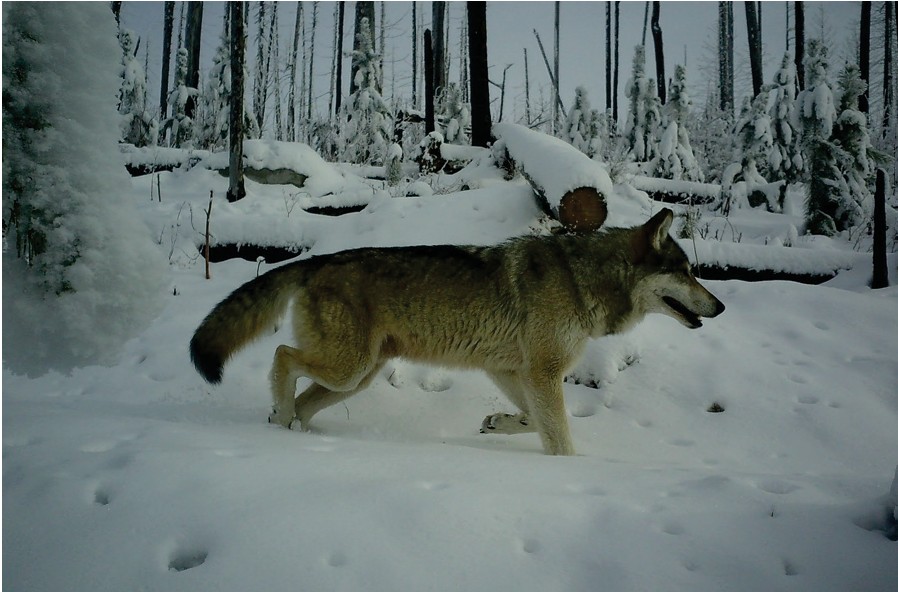
Washington’s gray wolf population hit its highest recorded level at the end of 2025, rebounding from a dip the previous year and raising cautious optimism among wildlife managers, though one key recovery region continues to lag behind.
As of Dec. 31, 2025, the Washington Department of Fish and Wildlife and partnering tribes counted 270 wolves, 23 breeding pairs, and 49 packs statewide. The previous year’s count stood at 230 wolves, 18 breeding pairs, and 43 packs, making 2025’s numbers a more than 17% increase in total wolves.
Pack sizes ranged from two to 12 wolves, with most made up of three to seven individuals.
*Gabriel Spence, wolf biologist with WDFW, said the rebound is consistent with how recovering wolf populations behave.
“Wolf populations are generally quite resilient and can recover quickly when conditions are right,” Spence said. “There were several factors that drove population growth this past year. In 2025 we had five more successful breeding pairs, five more packs and average pack size inched up slightly over what we had in 2024.”
Much of that growth came from the North Cascades, which added five breeding pairs and two new packs. Eastern Washington, meanwhile, stayed stable on breeding pairs while three packs reestablished there.
WDFW Wolf Biologist Trent Roussin identified the six new or reestablished packs by name. Reestablished packs include the Salmo, Smackout, and Vulcan packs in northeast Washington. New packs include the Cameron Lake pack on the Confederated Tribes of the Colville Reservation and the Billy Goat and Tupshin packs in the North Cascades Recovery Region.

Recovery Goals: Two Zones Ahead, One Stalled
Washington’s wolf recovery plan sets criteria for delisting across three geographic recovery zones. Spence said two of those zones have already surpassed their targets.

“Both the North Cascades recovery zone and the Eastern Washington recovery zone have met and exceeded the recovery goals set for them for complete delisting,” Spence said. “The numbers for successful breeding pairs in the North Cascades and Eastern Washington recovery zones exceed the total statewide recovery objectives for all three zones.”
The third zone, the Southern Cascades and Northwest Coast Recovery Region, is a different story. No packs or breeding pairs were documented there at the end of 2025, despite collar data and confirmed sightings indicating at least two wolves traveled through the area during the year.
Spence described the obstacles facing wolves trying to reach that region as significant.
“Wolves traveling to the South Cascades and Northwest coast from areas of higher wolf population must cross vast areas of open agricultural land in the Columbia basin, I-90 from the North Cascades, or the Columbia gorge complex of interstate highway, a busy state highway, heavily used railroad tracks, and the mile wide Columbia itself,” he said. “Wolves are amazing travelers and can and have crossed these barriers, but these obstacles do reduce the number who try and the number that survive the trip.”
He added that when the few wolves that make it to the region are killed, it significantly slows recovery. Wolves are federally and state endangered in the western two thirds of Washington, making any killing there subject to investigation as illegal take of wildlife.


Livestock Conflict Remains Limited
WDFW documented 17 depredation events (instances of wolves killing or injuring livestock) involving 19 cattle in 2025. Eight calves were confirmed killed by wolves, one was probably killed, eight were confirmed injured, and two were probably injured. Five of the 49 packs were involved in at least one confirmed or probable livestock injury or mortality, and three of those packs were involved in three or more depredations.
Roussin noted that 90% of known packs had no confirmed depredations despite most pack territories overlapping livestock operations on both public and private lands.
WDFW documented 28 wolf mortalities during 2025. That total includes 12 legally harvested by tribal hunters, four lethally removed in response to wolf-livestock conflict, three from unlawful take, three human-caused mortalities on tribal ground, two killed while caught in the act of depredating livestock, two natural causes, one related to WDFW capture and collaring work, and one unknown cause.

Dispersal a Sign of Population Health
Fourteen collared wolves dispersed from their pack territories in 2025, representing 28% of the collared wolves monitored during the year. Three dispersed out of Washington entirely, moving to Oregon, Idaho, or British Columbia.
Spence said that pattern reflects normal behavior rather than wolves seeking conditions unavailable in Washington.
“Most of the wolves that dispersed out of Washington lived relatively close to a state border, and since wolves often disperse to territories relatively close to their birth territory the fact that some leave the state seems like normal dispersal behavior as opposed to wolves seeking territories outside of Washington,” he said.
He described dispersal as a critical part of population recovery overall. “It also tells us that we have wolves surviving until dispersal age, which is crucial for new pack formation,” Spence said. “Dispersal is a normal part of a wolf’s life, most wolves will disperse from their birth pack somewhere between one and three years of age and try to find a mate and a territory of their own.”
Once wolves cross a state or international border, WDFW can continue tracking collared animals via GPS, but those wolves become subject to the management rules and laws of the state or province they are in.
The Washington Gray Wolf Conservation and Management 2025 Annual Report is available on the WDFW website. Contributors include the U.S. Fish and Wildlife Service, the National Park Service, the Spokane Tribe of Indians, Swinomish Tribe, Yakama Nation, and the Confederated Tribes of the Colville Reservation.
*This story includes responses from WDFW Wolf Biologist Gabriel Spence, who was interviewed via email.
[Featured Image courtesy of the Washington State Department of Fish and Wildlife (WDFW)]