
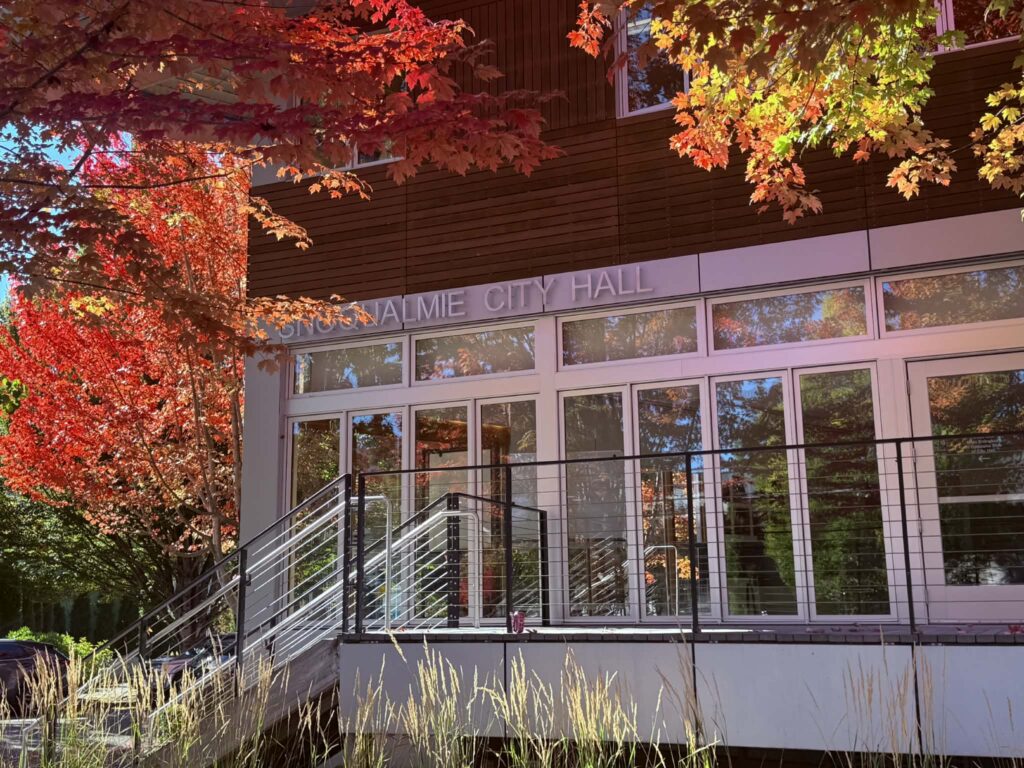
When James Mayhew ran for Mayor of Snoqualmie, he promised voters a leadership style grounded in transparency.
Mayhew said, “Transparency is essential to trust. Major issues should be discussed in public, with clear explanations of costs, trade-offs, and the reasoning behind each option. Residents deserve to see the full picture — not just a single preferred outcome — so they can meaningfully shape the direction of their city.”
But since March, residents attending city council meetings have found themselves listening to their neighbors speak at the podium without being able to see them. The camera goes dark during public comment, then comes back on. And when Living Snoqualmie asked why, the city could not provide documentation supporting it.
Snoqualmie is in the middle of its most significant community controversy in recent memory. More than 2,000 residents have signed a petition opposing a proposed battery energy storage facility that would sit adjacent to city limits, half a mile from an elementary school, and near Fisher Creek, which drains into the Snoqualmie River watershed. Council chambers have been packed for weeks.

At the March 23 city council meeting, the camera typically used to show speakers at the public comment podium was turned off. It was turned back on immediately after public comment ended. When asked for an explanation, City Communications Coordinator Scott Harder cited a 2019 council vote but was unable to provide a resolution number or any governing document supporting the current policy, despite multiple requests over three weeks.
On April 6, Harder wrote, “Our legal team is working on this as we speak. I’m sorry I don’t have an answer for you other than we are working on how the policy looks moving forward.” At the April 13 meeting, Mayor Mayhew told Councilmember Murphy, who had raised a point of order about the missing video, that it was “prohibited by council rules of procedure.”
Harder told freelance Living Snoqualmie writer Danna McCall that a resolution had been passed in 2019 governing the policy. When asked for the resolution number and a copy of the document, he provided a link to a YouTube video of the September 9, 2019, council meeting. When Harder was asked again for the resolution number, he replied, “All I can provide is that there was a resolution made by City Council back on Sept. 9, 2019.”
However, a review of city records shows that the two resolutions that govern Snoqualmie’s Council Rules of Procedure, Resolution 1454, adopted in 2018 and Resolution 1542, adopted in 2020, contain no language about video recording of public comment.

Resolution 1542 lists every amendment to the Rules of Procedure dating back to 2002. Nothing from 2019 appears on that list. What the record does show is a procedural motion, passed 4-3 at the September 9, 2019, council meeting, to stop recording public comments for items not on the agenda. A motion and a resolution are not the same thing. A public records request for the governing document has been filed with the city.
The 2019 motion, as passed, applied specifically to public comments on items not on the agenda. The BESS project has been a noticed agenda item at recent council meetings, including the April 13 meeting, where the camera was off during public comment.
On April 16, the council held a special meeting to discuss the BESS project. The published agenda included no opportunity for public comment. The meeting came as the council is also operating with a vacant seat. Councilmember Cara Christensen resigned effective March 16th as she and her family prepared to relocate. Applications for the position closed April 13, and candidate interviews are scheduled for April 27. Councilmember Robert Wotton was on an excused absence. Councilmember Daniel Murphy participated remotely. The meeting lasted 13 minutes.
The council remains divided on how to respond to the project. Councilmembers Murphy and Cotton have pushed for action. Murphy said at the meeting, “We’re running out of time to act, and the time to act is now,” and added, “There’s risk in remaining silent.” Councilmembers Holloway, Washington, and Johnson have urged caution, citing legal advice and the absence of a formal permit process. Councilmember Washington said he had spoken with many residents and agreed with their concerns but urged caution. “We just have to be careful because there’s a lot of risk that goes into this,” he said. The council took no action and adjourned at 7:15 p.m.
In the meantime, residents have continued to attend council meetings in large numbers, and the camera has remained off during public comment.


Comments
https://prod.livingsnoqualmie.com/in-close-vote-snoqualmie-city-council-suspends-video-recording-of-open-public-comment-portion-of-meetings/
In this Living Snoqualmie article, the PDC said the excuse used by Councilmember Holloway and ex-councilmember Mayhew to turn recording off when residents speak at city council meetings when talking about topics not on the agenda is not a problem, directly opposed to what Holloway and Mayhew claimed.
The Washington Coalition for Open Government has written letters to the City of Snoqualmie about their municipal code that significantly limits the man hours employees are allowed to use to respond to public records requests.
“Bryan Halloway and James Mayhew voted to limit public records access.”
Read more at: https://www.valleyrecord.com/2019/08/02/transparency-accountability-too-important-to-sacrifice-editorial/
When Snoqualmie Hills West was proposed in 2017, which would have had Snoqualmie annex the UGA where the BESS project is proposed, the council voted against the proposal because the city doesn’t have enough water for it. My understanding is that BESS facilities require a lot of water to fight fires. Snoqualmie is the only purveyor in the area and unincorporated King County buys Snoqualmie water. According to the City’s water plan, the city is running out of water in a handful of years, the city has applied for more water rights which have not been approved, the application date was decades ago.
King County had a regional study of water years ago, referred to by the Snoqualmie water plan, North Bend water plan and Salish water plan – who also refer to the region’s water study.
I have sent a number of questions to Sarah Perry’s office, I received a partial response
to my questions. One question that I haven’t heard anyone address and not answered by Perry yet is what are the requirements for decommissioning a BESS facility if it fails? According to MRSC, at least one King County city has that as a requirement to build a BESS facility.
What I am concerned about is that residents within a 30 mile radius should receive a US mailed notification about the BESS proposal from King County, because the MOSS BESS facility hospitalized people 30 miles away and now there are lawsuits against the county and state.
My understanding is that King County Council passed County code to build BESS facilities in King County.
It appears that a number of BESS facilities have been approved in WA; but only one in Yakima is operational and subsequently the Yakima County Council has banned more in unincorporated Yakima in order to study their safety.
Thank you for this additional information.