
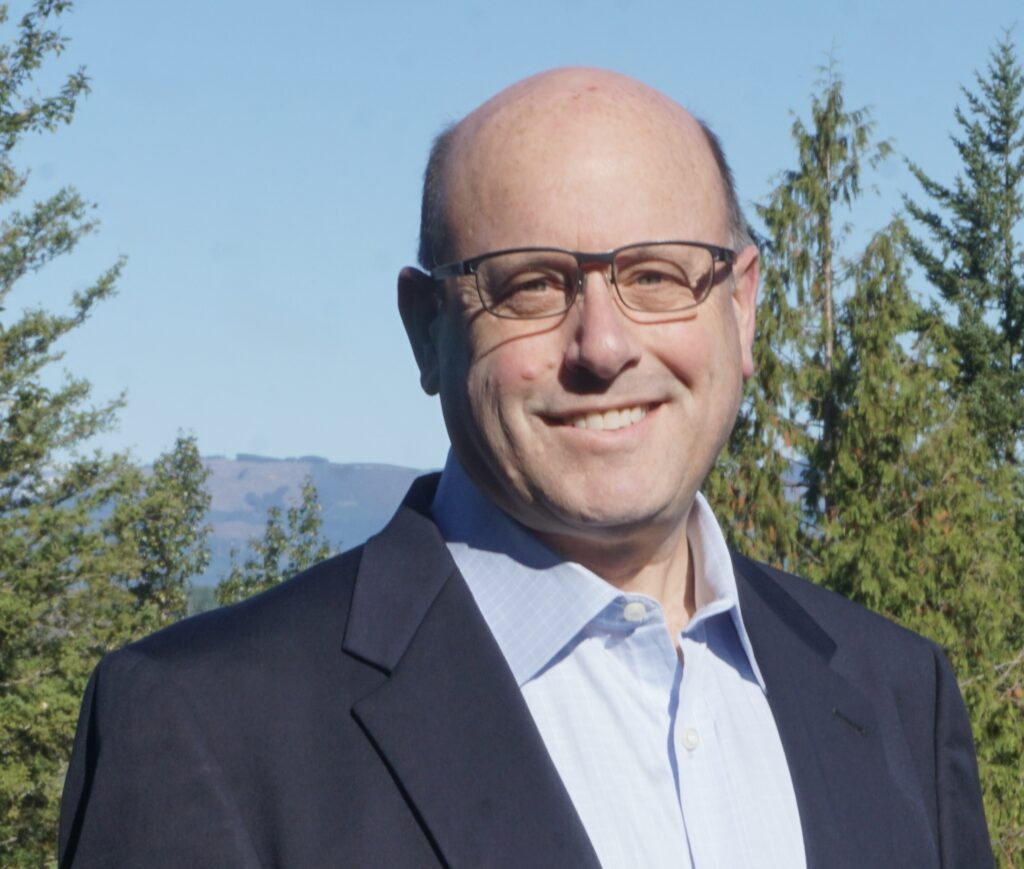
Candidate James Mayhew submitted answers to six questions we posed to him. Below are his unedited responses. After the Q&A, you will find his bio (also unedited) and links to his website for additional information.
The summer primary was held on August 5th. Ballots will be mailed out on October 16th, and the general election will be on November 4th.
1. Do you support Snoqualmie maintaining its own independent police force?
Yes. With the loss of the North Bend Police contract, Snoqualmie now faces a police funding gap. North Bend had been covering part of our police overhead and support costs, and losing that contract has forced discussions of staff reductions that threaten both patrol and support staff and our community’s sense of safety.
The cost of police services on each shift is determined by the number of officers on duty, regardless of how many calls they receive. Under its contract, North Bend paid the full cost of its assigned officers plus a substantial contribution toward overhead and support costs, increasing that share at each renewal. During the most recent negotiations, however, my opponent proposed dividing total costs by the number of calls and claimed North Bend was receiving a subsidy of more than one million dollars per year. That “creative math” did not reflect actual costs and led North Bend to contract with King County instead, costing Snoqualmie the overhead contributions it had long relied on.
Snoqualmie residents have consistently affirmed that they want a local police department, staffed by officers who know our neighborhoods and reflect our small-town values. Within the past decade, voters twice supported additional public-safety funding, in 2017 by 58 percent and again in 2024 by 66 percent, showing clear and sustained support for local policing.
I believe in maintaining our own department, with both patrol and support positions adequately funded. While the cost of alternatives deserves open discussion, they cannot replace the value of officers who know and serve our community.
2. Snoqualmie has lost many officers since May, with no public replacement plan. With the North Bend contract set to expire in March, how will you ensure both cities have adequate police coverage in the interim?
Police officers and support staff have families to support and careers to manage. During times of uncertainty, strong leadership is essential to keep people focused and morale high. That means clearly communicating which positions may be affected, when changes will occur, and how individuals will be supported. It also means providing transition assistance and bridge pay for staff who are leaving through no fault of their own. These steps not only help them secure good opportunities and reduce the risk of early departures—but, most importantly, they reflect the right way to treat those who have put their lives on the line for us every day.
Unfortunately, that has not been the approach taken. A costly lawsuit with North Bend created confusion over future funding, while staff were left with vague and inconsistent information about potential cuts. Many officers and support employees were left wondering who might be retained, when decisions would be made, and what transition assistance—if any—would be available. Compounding this uncertainty, my opponent has repeatedly and falsely claimed that I would eliminate Snoqualmie’s police department and outsource services entirely. That claim is untrue.
Throughout this period, I have worked to promote stability—meeting with police officers, Snoqualmie councilmembers, and North Bend’s mayor and council to encourage compromise and help both cities end the lawsuit. I was deeply relieved when that resolution came. I issued a public statement affirming my strong support—and the community’s clear support—for maintaining our own independent police department. I’ve also met with officers to explain my approach if elected.
3. Relations between Snoqualmie and North Bend are currently strained. What specific steps will you take to repair that relationship?

Healthy relationships, whether between people or between cities, depend on trust, communication, and respect. Both cities share residents’ frustration when partnerships falter, and both benefit when cooperation is rebuilt. Rebuilding begins with listening to understand the why, and then refocusing on shared goals.
Snoqualmie and North Bend have far more in common than in conflict: strong schools, a connected workforce, a shared downtown tourism economy, and residents who cross city lines daily. Economic vitality, visitor attraction, and the preservation of our small-town character are mutual priorities. By aligning tourism efforts and branding the Valley as a single, compelling destination, both cities can thrive year-round.
Rebuilding trust means starting now and achieving small, visible successes. Joint initiatives such as advancing a regional aquatics center that serves both communities offer a tangible way to demonstrate partnership, spread costs fairly, and deliver something residents on both sides have long desired.
Since the police contract decision, I have been meeting regularly with North Bend’s mayor and several of their councilmembers to explore ways we can work together on these shared priorities. Elected leaders in both cities clearly care about their communities and want success, so I am encouraged and committed to continuing this work to strengthen collaboration.
When leaders model respect and cooperation, relationships heal and both communities move forward stronger together.
4. How would you work to increase tourism revenue in downtown Snoqualmie while managing traffic impacts on the community?
Our small retail businesses often struggle during the winter months as both local and visitor traffic slows. They provide the restaurants, shops, and services that make daily life here more enjoyable and convenient. When they prosper, we preserve the vibrant, small-town character we all love.
Local businesses operate on thin margins, and because we don’t have large retailers, their total sales are modest as a tax source. Rather than viewing them primarily as revenue generators, we should see them as vital to Snoqualmie’s community character and promote their success for that reason.
In recent years, the city hasn’t done enough to showcase or support our business community. We need to do much more to help existing businesses thrive, attract new ones, and market Snoqualmie as a collective destination. Individual businesses advertise themselves, but they need the city’s help in promoting the breadth and variety of restaurants and retail together. That means better advertising to residents about the options already here; to Snoqualmie Falls visitors, Twin Peaks tourists, and those drawn for parks, recreation, biking, and other outdoor activities; and partnering with the Chamber of Commerce and nearby cities to promote the Upper Valley under a shared brand that includes Snoqualmie and leverages the limited resources of each. We should also increase and improve event coordination—expanding the number of events that draw visitors while keeping flows well-paced and supported by adequate parking and active management.
Tourism strengthens that vitality by helping local businesses remain here year-round, even though resident spending alone may not sustain them. Balanced growth—supporting local businesses, welcoming visitors, and preserving the livability that makes Snoqualmie home—should guide every decision.
5. The YMCA Community Center Expansion Project is now estimated at $30.2 million, with $19 million in capital funds committed and a $10 million funding gap remaining. Should the city continue holding these funds for this project, or redirect them elsewhere?
To ensure we don’t expand services during temporary boom times that can’t later be sustained without tax increases, Snoqualmie funds its annual operating costs only from recurring revenues. During the Ridge build-out, construction sales taxes were set aside for future one-time needs, creating a Capital Fund of about $15 million. But that build-out is complete—once we spend these funds, they won’t be replenished.

Our community center, operated by the YMCA, was originally envisioned as larger, but the city then was smaller and couldn’t afford it. As a result, it lacks many spaces a full facility would offer—rooms for gatherings, senior and youth activities, and educational programs. And despite Snoqualmie having one of the highest ratios of children per household in the state, it has no public pool.
Many residents see a public aquatics facility as the most significant missing piece in our community. The current $30 million proposal lacks adequate deck, changing, and spectator space for swim meets and provides limited community-center expansion. A facility that truly meets community needs would likely cost $40 million or more, leaving a shortfall of roughly $25 million—about $5,500 per household if operated alone—and would require $1–2 million in annual operating support, or about $350 per household if operated alone.
I support bringing residents together soon for open town-hall meetings—ones that are truly collaborative, not one-way sales pitches—to decide which investments matter most. If aquatics is the priority, I favor a regional partnership that spreads costs fairly among all users and unlocks county, state, and school-district funding.
6. What is one common misconception voters may have about you or your leadership style, and how would you like to address it?
My approach to leadership is grounded in collaboration, transparency, and professionalism — shaped by six years on the Snoqualmie City Council and a career in executive leadership in the private sector. Those experiences have reinforced a simple truth: the best decisions come from engaging people early, listening carefully, and building consensus through facts, not assumptions or personal preference.
Transparency is essential to trust. Major issues should be discussed in public, with clear explanations of costs, trade-offs, and the reasoning behind each option. Residents deserve to see the full picture — not just a single preferred outcome — so they can meaningfully shape the direction of their city.
I also recognize that not every decision leads to the outcome each person hopes for. At times, that can lead to disappointment or even a feeling that trust has been lost. But genuine trust isn’t built on always agreeing — it’s built on knowing that your input was heard, that information was shared openly, and that decisions were made with the community’s best interest in mind. My commitment is to ensure that process happens every time.
Professionalism means empowering staff to bring forward their best analysis, even when their conclusions differ from my own. Fiscal responsibility underpins it all — with sustainable budgets, fair cost sharing, and regional cooperation. Ultimately, leadership is about helping residents understand choices, feel heard, and work together toward shared priorities for Snoqualmie’s future.
Candidate Bio with Linked Website
James Mayhew: My family and I have lived in Snoqualmie since 2009 and our two sons grew up here. I have served our remarkable community since 2017, including dedicating significant time for six years as a Snoqualmie councilmember. Giving back to my community has always been a priority; I have been involved in community non-profit boards throughout my life. In my professional career I served as the Chief Financial Officer for a fortune 1000 company, was a partner in the accounting firm of KPMG, and was a Certified Public Accountant. I graduated from the University of Washington with a degree in Business Administration.
Learn more at: http://vote4mayhew.com/


Comments
I’m really pleased to see that Living Snoqualmie has been able to get responses from both mayoral candidates for Snoqualmie.
We are fortunate to have two good candidates to choose from, and I urge Snoqualmie residents to study the positions and character of each to determine their choice.
(As a resident of North Bend, I don’t have a vote in this!)
I reside in North Bend so I cannot vote in Snoqualmie’s elections, however I was wondering these last few days about the statements North Bend was “taking” Snoqualmie for 1 million dollars on the Police Contract as Mayor Ross gave no explanation other than the 1-million-dollar statement. Now since reading the explanation above – I would agree it is “creative math”. Both Cities agreed to the Police Contract and as in all contracts the money/personal / duties were spelled out in great detail. Personally, I recommended to the North Bend Council to stay with Snoqualmie Police as their department had been trained well by Chief Perry Phillips to be PROACTIVE law enforcement versus the County Police being REACTIVE – in other words Snoqualmie contacted vehicles and people for violations of the law which led to warrants, DUI, suspended drivers, felons, criminal acts and if warranted they went to jail. Reactive law enforcement is dispatched calls for service – when dispatch broadcasts a call over the radio for service then the officer proceeds to that call location. Lastly Snoqualmie Police were always in North Bend with the Sergeant and Officers doing their job – politics by both cities at the higher levels overshadowed this point and gave the opening King County Police needed to bid on a city contract to avoid county budget layoffs of deputies at the time.
In closing I have not met nor support either candidate for Snoqualmie Mayor. I do enjoy watching their televised city meetings on the web.
Chris Lodahl, North Bend Mayor 92-95 and retired law enforcement detective