
Update: The Snoqualmie City Council is scheduled to vote during a special meeting on Monday, August 3, on whether to place the proposed property tax levy measures on the November ballot. Read the city’s explanation of Monday’s vote here.
As Snoqualmie Mayor James Mayhew presses the city council to quickly decide on a November property tax increase ballot measure to close a budget deficit and avoid service level reductions, councilmembers asked for a meeting to hear directly from residents on the controversial topic.

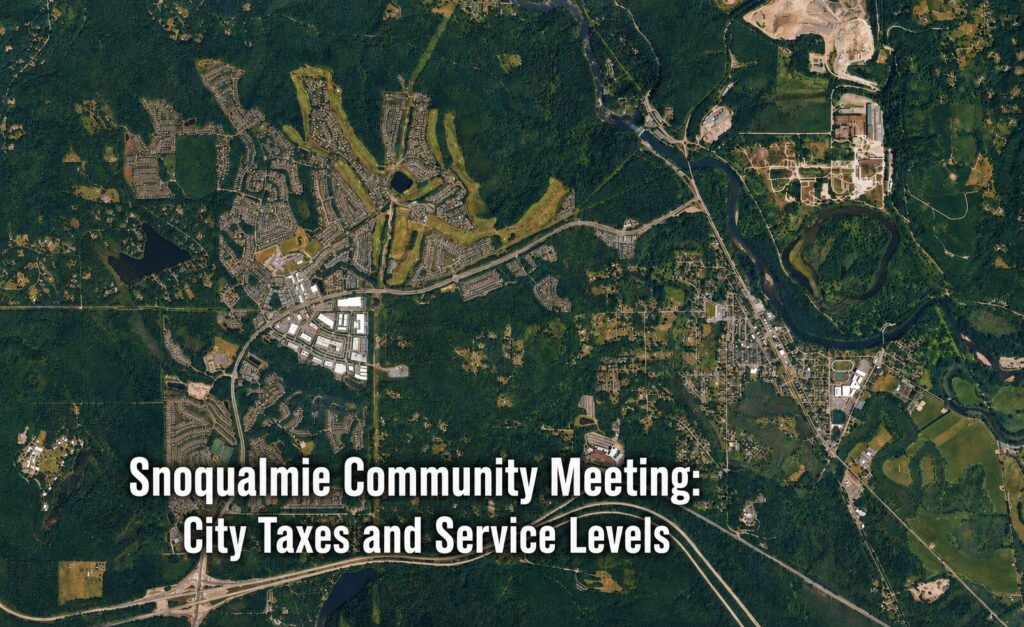
Residents are invited to a community meeting on July 29 to learn about the city’s current service levels and share thoughts about possible service reductions and/or property tax increases. The meeting happens from 6-7:30 pm at the Snoqualmie Valley YMCA, 35018 SE Ridge Street.
Can’t make the meeting? You can also email the Snoqualmie City Council to provide feedback at [email protected] or provide feedback during public comment at the July 27 regular city council meeting.
Be advised: the July 27 City Council meeting agenda includes an agenda bill with a resolution for a property tax levy lid lift. It is unclear if the council will vote on that agenda bill before holding the July 29 community meeting. A recent news release states, though, that the city wants to hear directly from residents before deciding to move forward with the ballot measure.
Mayor’s Proposed 10-year Budget-Fixing Tax Increase
Mayhew’s proposal could fix a projected $1.5 million budget shortfall in the city’s 2027 budget, as well as add another $1.9 million to that budget to restore city staffing to 2019 levels and modernize operations.

In 2027, for the average Snoqualmie household, that would mean a $49 monthly property tax increase ($588 annually), and potentially more in the following years if the 10-year levy lid lift was approved by voters.
The mayor’s tax increase proposal has two parts: 1) In 2027, a permanent $3.4 million property tax increase (significantly above the allowed 1% cap) to cover the $1.5 million predicted budget shortfall and another $1.9 million to modernize the city and restore services reduced in recent years. 2) In 2028-2036, adjusting the levy limit for inflation and population growth, which is often higher than the state-allowed 1% cap.
Without a tax levy increase, the mayor’s budget presentation shows the city would need to trim approximately 6% of expenditures -or $1.5 million – to close the predicted 2027 budget gap. The mayor stated he has no cuts to offer, and any reductions would need to be directed by the council. A November 2025 budget and financial forecast presentation to council, though, showed a smaller, $500,000 budget gap for 2027. Additionally, during the recent June 22 council meeting, a budget forecast document was shared with council showing a $100,000 deficit for 2027
July 22 City Council Special Meeting Recap
At a recent city council special meeting, Mayor Mayhew presented on the budget again -this time for about 1.25 hours, after which councilmembers provided feedback and asked questions.
Some councilmembers continued to push back on a ballot proposal for a tax increase. Councilmember Cotton spoke to “tax fatigue” within the community; noting many people struggling to get by; and the statistics of households utilizing the local food bank.
Given that the mayor’s 10-year proposal, Councilmember Murphy requested estimates for property tax increases beyond 2027. Murphy also said that while he was glad they were hosting a community meeting on the topic, it felt like the meeting was a “token ask” because public engagement was condensed into a short amount of time.
Councilmember Wotton expressed concern over what he viewed as a “rushed process.” He requested more time to evaluate staffing levels since most of the mayor’s proposal was to fund new staff positions. He said he was unsure if they needed to restore all service levels and positions that the city had in 2019, questioning if that was financially sustainable going forward.

Councilmember Testman mentioned not having a “demand signal” from residents saying city service levels weren’t sufficient, which for him would show a need for a levy lid lift. He said the upcoming town hall would be an opportunity to hear more on that.
Councilmember Johnson said the current decision before council isn’t to impose a tax, but to ask voters if they potentially want “massive cuts” that in his opinion could raise legal questions regarding if they [cuts] are even allowable.
Councilmember Holloway provided specific feedback on some proposed budget items he thought could be eliminated and asked for more information on other items.
Snoqualmie Recent Tax Increases
The City of Snoqualmie last asked voters for a property tax levy lid lift in 2017 – described then as a public safety tax increase – which funded two police officers and one more firefighter. Then in 2021, the city asked residents to approve .02% sales tax increase to fund a transportation benefit district (TBD) for improvements to streets, sidewalks, etc. In 2024 residents were then asked to approve a .01% sales tax increase to support public safety. All three measures were approved. In 2024, the city council also approved a .01% increase to its TBD. These sales tax revenue generating measures helped offset historic inflationary pressures in the wake of the pandemic, as well as the loss of significant tax revenue when the Salish Lodge and nearby properties became tax exempt.
Washington state law prohibits taxing jurisdictions, including cities, from raising taxes by more than 1% per year without approval by voters. The allowed 1% increase is historically outpaced by inflation and is the reason many cities consistently face revenue and budget challenges.
North Bend Police Contract Impact
The July city news release noted the loss of the North Bend police services contract as a reason for part of the budget shortfall. Without the contract, the shared funding model for some Snoqualmie police department positions ceased. North Bend had paid 50% (or $480,000) of four sergeant positions, as well as a portion of the SPD captain and chief’s salaries (approximately $57,000). Snoqualmie now solely pays those salaries with the positions no longer having North Bend job responsibilities. Snoqualmie did eliminate some police department positions when the contract ended, including 8 North Bend patrol officers, one administrative sergeant, and one support tech. According to the same news release, additional revenue from North Bend police contract was anticipated to help offset inflationary pressure on the city’s budget.

Comments
Not a chance mayor . Trying to rush it down our throats, Your going to be a one and done mayor
No thanks. We need a discussion of services and proposed cuts first. There is not a chance I would support a levy lift with no transparency or accountability. I think the Mayor’s lack of experience is showing.