~Guest Post by the Snoqualmie Valley Historical Museum
Long before the Snoqualmie Valley was covered with farms, barns, dairies, and fields, it was already a productive food landscape.

For the Snoqualmie people, food came from the rivers, forests, prairies, wetlands, and mountains of their homeland. Native people gathered roots and berries, fished for salmon, hunted, and traveled seasonally to resource-gathering areas. Prairies were managed through burning to encourage useful plants and attract game.
The arrival of Euro-American settlers in the nineteenth century began a dramatic transformation of that landscape.
Clearing the Forest
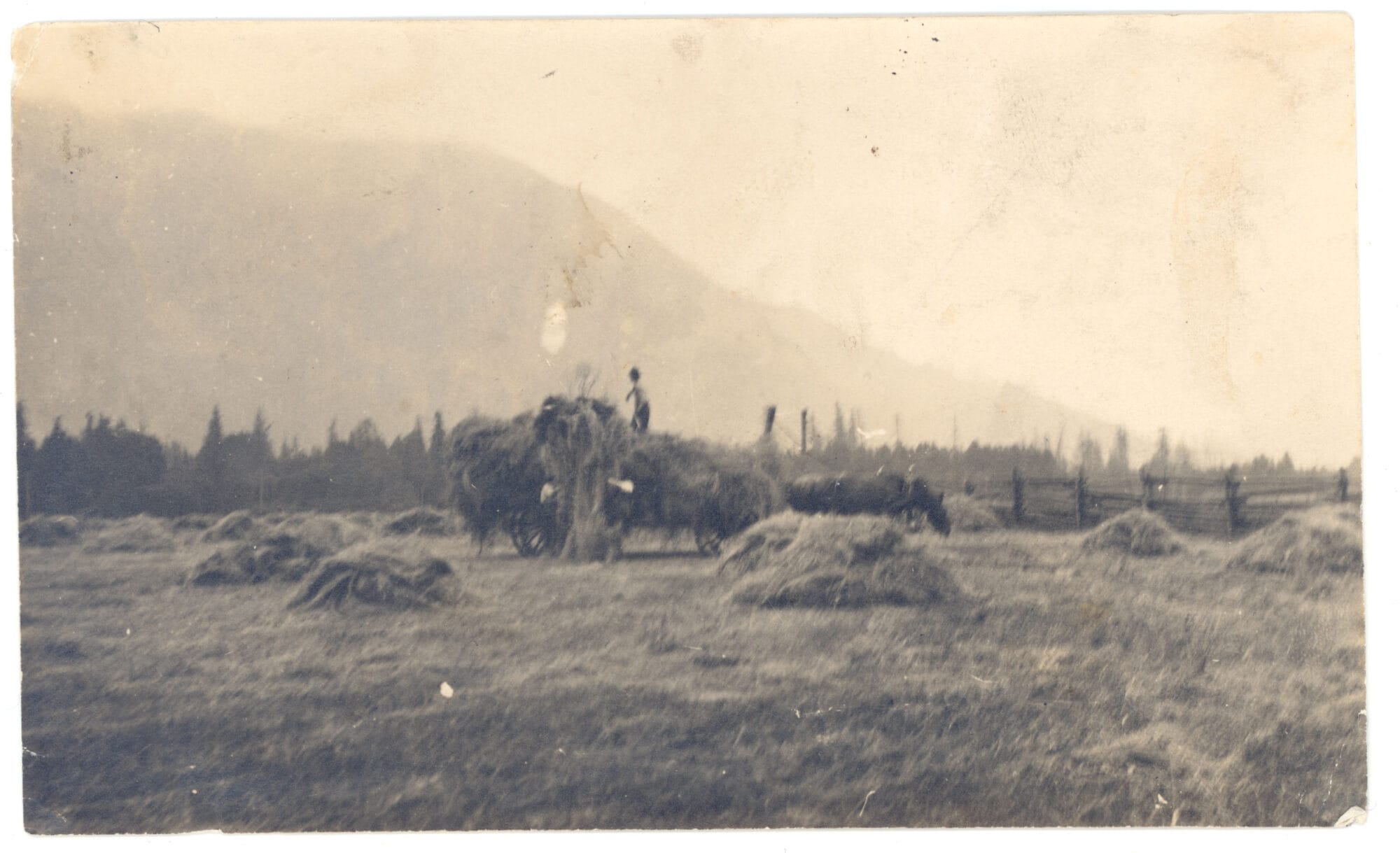
For early settlers, creating a farm meant clearing trees, removing stumps, and turning forest and wetland into fields and pasture. The fertile floodplains of the Snoqualmie and Tolt Rivers offered productive agricultural land, although they also brought the constant challenge of flooding.
Early farms were often small, family-run operations. Families grew food for themselves, kept livestock, planted gardens and orchards, and gradually began producing enough surplus to sell or trade.
Livestock became important surprisingly early. The Snoqualmie Wagon Road provided a route across the Cascades, and settlers in the upper Valley provided pasture for cattle being driven from east of the mountains toward the growing markets of Seattle.
Agriculture was already connecting the Valley to a much larger regional economy.
The Hop-Ranch Era
In the late nineteenth century, hops became the Valley’s most spectacular agricultural crop.
Hops had been introduced to King County in the 1860s, and by the 1880s the Snoqualmie Valley was home to one of the largest hop operations in the region. The Snoqualmie Valley Hop Ranch was established on land originally associated with pioneer Jeremiah Borst. The operation eventually grew to more than 1,000 acres, with several hundred acres planted in hops.
At harvest time, the ranch became a remarkable seasonal community. As many as 2,500 to 4,000 workers were needed at the height of the harvest. Native families traveled from throughout the region to pick hops, with women and children working alongside men. Workers often lived in temporary camps, cooked their own meals, and sometimes sold handmade baskets and other goods.

The hop harvest even became a tourist attraction. Visitors came to watch the spectacle, and the ranch owners built the three-story Meadowbrook Hotel for travelers.
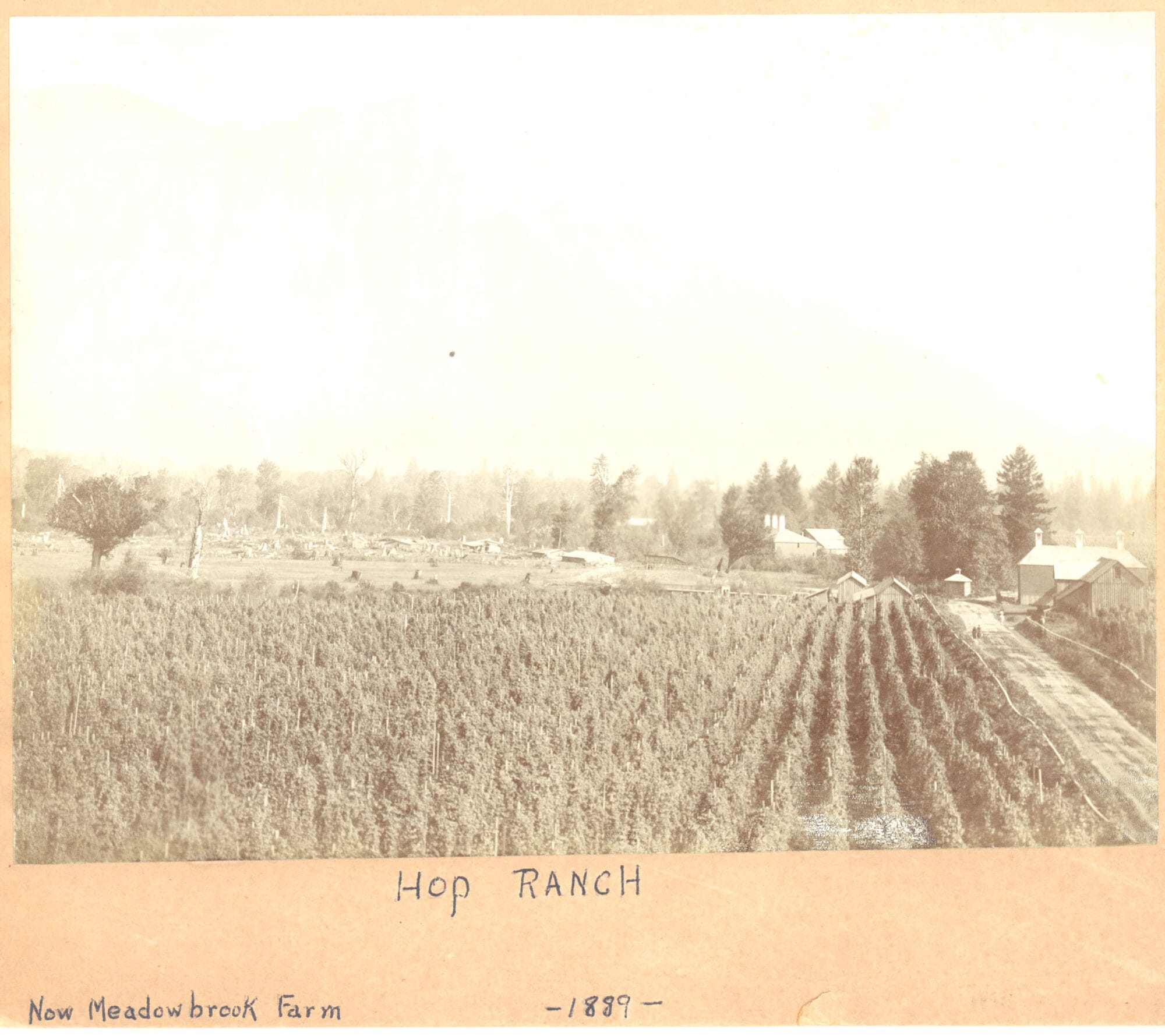
But the boom was short-lived. Beginning in 1889, aphids damaged the crop, while falling prices, oversupply, and competition from Eastern Washington further weakened the industry. By the early twentieth century, large-scale hop production in the Valley had largely disappeared.
The agricultural landscape changed again.
From Hops to Hay and Milk
As the hop industry declined, dairying became increasingly important.
The Valley’s wet climate was ideal for growing grass and hay, while improvements in roads and rail transportation made it possible to move milk to urban markets. By the turn of the twentieth century, dairying had become a major agricultural enterprise in the Snoqualmie Valley.
The farm itself changed as well. Dairy farms required barns, hay storage, milk houses, pastures, wells, fences, and other specialized buildings and structures. What looked like a simple farmstead was actually a complex working landscape.
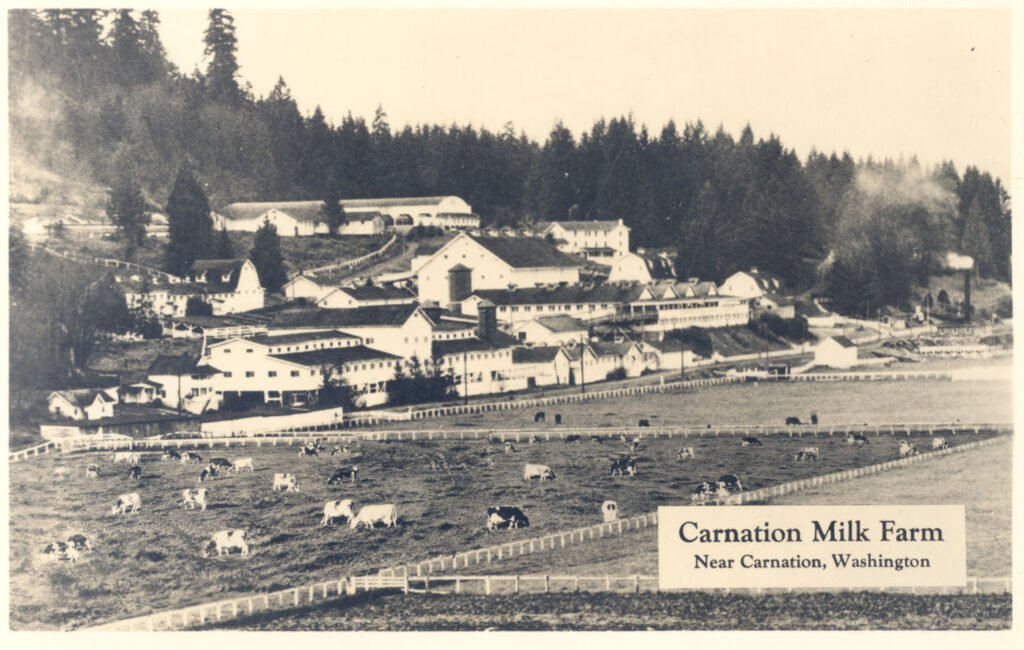
In 1909, E.A. Stuart established a model dairy near Tolt that would become closely associated with the Carnation Milk Products Company. The 360-acre ranch along the Snoqualmie River featured purebred Holstein cattle and demonstrated modern dairy practices.
The Valley was becoming known for milk rather than hops.
Getting Food to Market
Transportation played a crucial role in the transformation of Valley agriculture.
Early farmers were largely producing food for their own households and nearby communities. Roads, steamboats, and especially railroads opened much larger markets.
The arrival of the Seattle, Lake Shore and Eastern Railroad in the 1880s connected the Snoqualmie Valley with Seattle and other communities. Farmers could ship agricultural products out of the Valley and bring manufactured goods and other supplies back.
A photograph of milk cans waiting at the North Bend Depot offers a wonderfully simple illustration of this connection. Milk produced on Valley farms was no longer simply consumed at home—it was part of a commercial food system connecting rural farms with growing towns and cities.

Living With the River
The Snoqualmie Valley’s greatest agricultural advantage was also one of its greatest challenges: water.
The rich floodplain soils created productive farmland, but floods could destroy crops, damage buildings, and interrupt transportation. Farmers gradually altered the landscape through drainage, diking, and other efforts to control water and make more land available for cultivation and pasture.
Historic photographs of Valley floods remind us that agriculture was never simply a matter of planting and harvesting. Farmers had to adapt constantly to the river and the landscape around them.
A Changing Food Landscape
The agricultural history of the Snoqualmie Valley is a story of continual change.
The landscape first supported Indigenous foodways developed over generations. Euro-American settlement brought small family farms and livestock. The Valley then experienced the extraordinary rise and fall of the hop industry before shifting toward hay, pasture, and commercial dairying.
Throughout these changes, agriculture remained connected to transportation, labor, commerce, technology, and the environment.
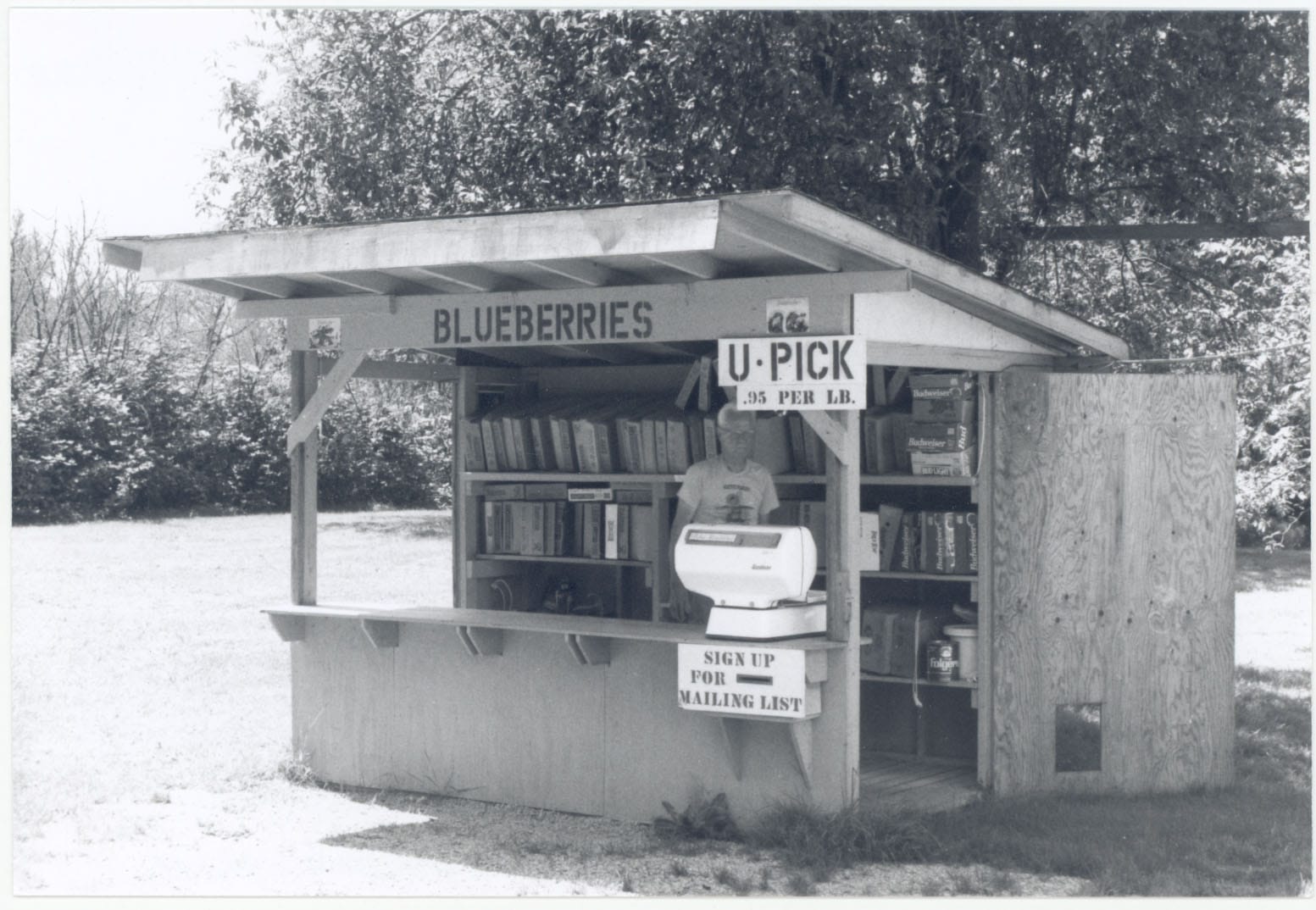
PO-40-1322- Blueberry Farm Stand- North Bend Town
Today, fields and barns may look like a permanent part of the Snoqualmie Valley landscape. But they represent only one chapter in a much longer story of people producing and gathering food here.
From salmon and berries to cattle and milk, the Valley has always been a place where people found ways to turn its remarkable landscape into food.
And the photographs preserved by the Snoqualmie Valley Museum help us see that history—not as an abstract story of crops and markets, but as a story of farms, families, workers, animals, buildings, rivers, and the everyday work of feeding a community.
[All images courtesy of Snoqualmie Valley Historical Museum. Featured image: PO-329-17- Carnation Milk Farm- Carnation Town]