
[By Peter Lugli, Director, Snoqualmie Valley for Responsible Energy. Views expressed are those of the author, not the Living Snoqualmie website. You may submit letters to [email protected].]
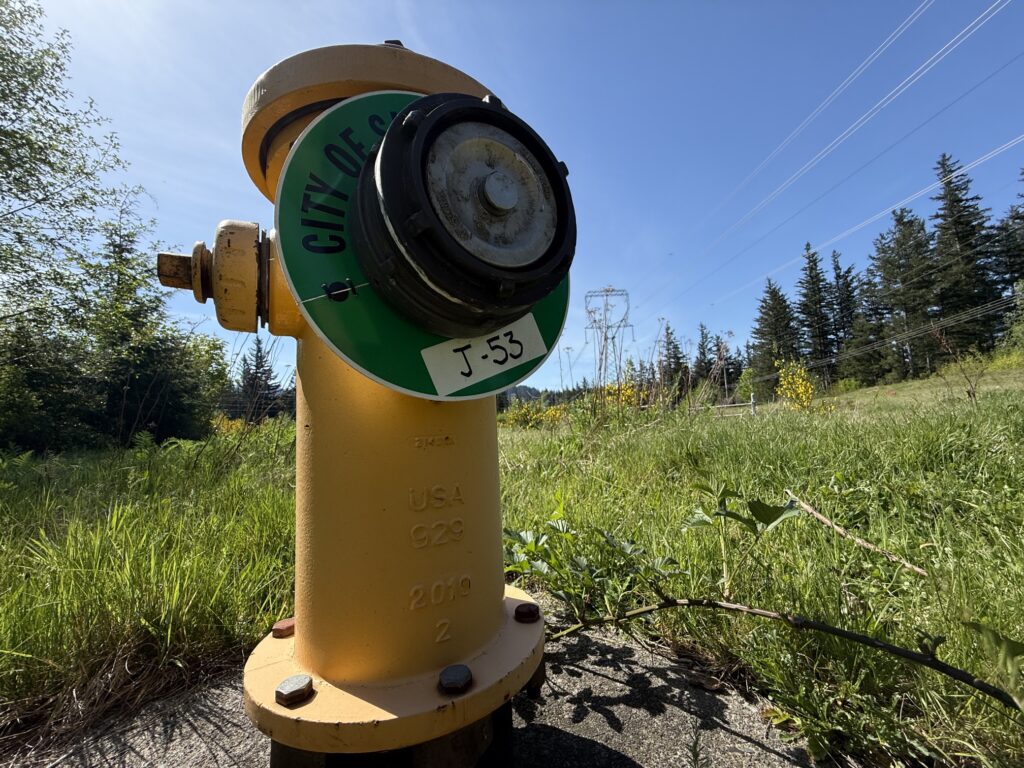
A yellow City of Snoqualmie fire hydrant stands at the end of Douglas Street SE, right next to the Mt. Si substation.
Hydrant J-53.

Lonely but proud, she stands as a silent sentry at the end of a paved road. A red-and-white hatched sign lies in pieces nearby, her only neighbor. Thorns and thistles abound, as if to ward off threats. Towering electrical lines hum and crackle overhead as a torrent of electrons races toward destinations unknown. A place of true solitude.
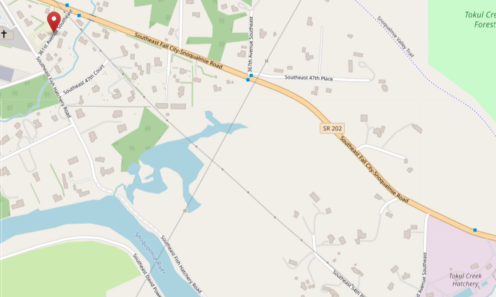
But note: Hydrant J-53 stands near a boundary. A boundary between the City and unincorporated King County. And it’s in unincorporated King County where Puget Sound Energy, in stealth over the past few years, hired a battery peddler, Jupiter Power, to build a massive energy storage complex.
Hydrant J-53, proud as she stands, may soon find herself forced into a job for which she never signed up – and no one intended. We must protect her now, before it’s too late.
PSE’s Hidden Jupiter Powers
Jupiter Power wants to build a vast lithium ion battery energy storage system, or “BESS”, for Puget Sound Energy. It would be located in unincorporated King County, less than 1,000 feet away from homes, families, schools, businesses and places of worship. This BESS beast would be equivalent to 7,000 Teslas spread across more than 34 football fields. PSE’s idea: store energy when demand is low at night, discharge it when demand is higher during the day. Call the whole thing modern grid reliability.
Fine. That is the sales pitch.
But batteries, however gleaming and elegantly described in project websites, remain stubbornly chemical. And lithium-ion battery installations of this size get people to ask very simple common sense questions.
Questions about fire. Big, scary, dayslong fires.
And water.
Fire Walk With Jupiter – The Bizarro Version
If you spend enough time digging through Jupiter’s mountain of submissions, as we have, you discover several things that are not as comforting as the public-relations gloss.
Jupiter’s own Emergency Response Plan says the battery units are not equipped with any automatic or manual fire suppression systems. In the section titled Fire Suppression Systems, we’re quoting here: “The . . . BESS is not equipped with any automatic or manual suppression systems.”

You would think that a big document with a section titled “Fire Suppression Systems” would, you know, talk about a fire suppression system. And yet, it says there is no suppression system.
That’s odd. But thank goodness, there’s another section titled Fire Protection Water Supply. Sounds promising. But: “A 30,000-gallon fire water storage tank is proposed for the site. This water shall be used for exposure cooling only, not offensive firefighting of fires involving battery cabinets.”
In plain English: there is nothing to suppress fires. A 30,000 gallon water tank is there to cool nearby equipment while the burning battery cabinet burns.
Our document summary gets worse.
In the event of a fire, Jupiter’s fire training materials state that because of venting conditions and the lack of a listed suppression agent, “no attempt should be made to suppress this fire”. They recommend a “defensive firefighting strategy”. Responders should establish an exclusion zone and “allow the event to run its course.”
We are not making this up. In plain English: “let ’er burn”.
So what does a ‘defensive firefighting strategy’ really mean? We think it’s equivalent to “Just Watch” or “Yeah, Hank’s turn tonight for the marshmallows and s’mores”. Take a moment to feel for the firefighters called into a potentially lethal lithium fire situation to just… watch. Potentially for days, affecting emergency response capabilities in the community.
From Bizarro to Fact – Why Water on Batteries is a Bad Idea
And this is where we dig into the science – even if it leads to more discomfort.

Water can be a bad tool for lithium fires because it may either react dangerously with lithium metal, or, in lithium-ion battery fires, fail to stop thermal runaway while creating electrical and toxic-runoff problems. Hence Jupiter’s ‘let ‘er burn’ strategy.
But the challenge with the Bizarro approach to BESS fires is that the BESS is not sited somewhere in the Sahara Desert. It’s here – abutting Snoqualmie, hundreds of feet away from hundreds of homes, several parks, multiple businesses and less than a half mile away from schools, churches, and childcare facilities.
And feet away from surrounding trees.
If flames, embers, or heat begin threatening nearby vegetation or neighboring property – particularly with Snoqualmie Valley wind gusts topping 60mph – you absolutely want water. You want lots of it. You want it reliably available. You want it immediately.
How much water? Well, even if you don’t want it to douse lithium ion battery fires, you will want it to keep surrounding areas cool from any possible flames. So assuming a LI battery fire pops up, you may want to put down the marshmallow sticks and continuously douse the trees and flammable materials around the BESS. So how long will you want to do that?
Well, the 2025 fire at the Vistra Moss Landing Battery Storage Facility required roughly three days of active fire management, from January 16 through January 18, 2025.
Assuming a worst case scenario (which County and City planners and permit-providers hopefully do) three days’ supply of water from a single hydrant is closer to 2,160,000 gallons of water – not 30,000. (and that’s assuming a paltry 500 gallons per minute, and if, as many municipal hydrants are rated at 1,000 gallons per minute, you’re looking at 4,320,000 gallons).

Jupiter, it seems, has a big water problem. At least a 2,000,000 gallon water problem.
We read about electrical utility involvement in the Camp Fire in 2018. PG&E’s wildfire liabilities, including the Camp Fire and other fires, ran to roughly $25.5 billion and helped drive the company into bankruptcy. A BESS near Snoqualmie seems like a pretty bad dice roll for PSE, even with stalwart Hydrant J-53 nearby.
Water, water, anywhere?
So let us dispense with the fiction that City of Snoqualmie water is not in play. It is.
If Jupiter’s unresolved 2,000,000 gallon deficit veers toward the City of Snoqualmie water supply, then the City of Snoqualmie needs to understand exactly what it is being asked to do.
Not as some friendly municipal courtesy.
Not as a harmless pipe.
Not as a minor little engineering tweak.
Jupiter is likely counting on the City of Snoqualmie to provide the public-water backbone for a private industrial battery project outside the City, for a fire response doctrine that does not contemplate traditional suppression of the burning battery cabinet itself, to mitigate the risk of a potentially cataclysmic fire event.
No Hydrant J-53 for You!
And that is why the City of Snoqualmie should say no.
No, the City should not become the enabling water source for a parched PSE battery project. No, the City should not worsen Snoqualmie Valley’s legitimate worries over water flow. No, City hydrants should not become the missing piece in somebody else’s massive water deficit. No, City infrastructure should not be drafted into potentially multi-day emergency service for a project outside the City line, after the risks were foreseeable, the questions were obvious, and the answers were left vague.
If Jupiter wants to build this PSE project in unincorporated King County, then Jupiter and PSE should not be allowed to assume access to Hydrant J-53 or any other Snoqualmie water source as part of the project’s fire-water solution. King County permit examiners now considering the Jupiter permits should require that.

And King County Executive Girmay Zahilay should exercise his discretion today to direct a County-level safety and emergency readiness review of the Snoqualmie BESS—focused on fire suppression capability, water availability, evacuation feasibility, and interagency coordination—so that King County is fully prepared before any permit approvals move forward. He has that discretion – he should exercise it.
We love you just the way you are, Hydrant J-53!
Hydrant J-53 has done nothing wrong and should not be penalized for the short-sighted thinking of a utility and its vendor seeking to build massive fire risks in unincorporated King County. She is fine doing exactly what she is doing, where she is doing it: yellow, solitary, and solidly within City of Snoqualmie boundaries.
If you can, show her some love and support by driving by and saying hi and thank you, Hydrant J-53! Or help us keep Hydrant J-53 the way we like her.


Comments
Excellent analysis and comment about the unacceptable risk of BESS at this site. We all know that PSE is (wink, wink) going to poopoo the BESS fire risk.
That was their out of the gate tactic. We all know they will want to connect to our water sources. And we all know if/when the worst happens that they will tapdance out the nearest exit. Thank you for your excellent work!
this is an excellent and elegantly constructed argument that highlights reasons not to allow the building of BESS.