-Guest post by Deborah J. Isley, volunteer Snoqualmie Valley Museum
Summer was coming early to Seattle and the Snoqualmie Valley in May 1922. A Seattle Times editorial encouraged the city to open at least three swimming beaches early. The final three days of May brought record-breaking highs in the 80s, with the 31st expected to be even hotter.
Ominously, humidity was dropping and the wind was picking up from the east. The stage was set for catastrophic fire. Thirty miles east of Seattle, in the upper Snoqualmie Valley, the small forested community of Cedar Falls was home to the hydroelectric plant that powered much of the city.
On the morning of May 31st, the children of Seattle City Light employees woke to hot, gusty weather at Camp 2, a mile uphill from Cedar Falls. Sixteen-year-old Randall Rydeen later recalled seeing scattered smoke and lightning on Mount Washington as he walked to school that morning. The students were just starting their school day when Randall’s friend Emmett came in and said that a fire had broken out on the mountain and was racing downhill. Camp 2 was in danger. Randall and other older students immediately left to help fight the fire.

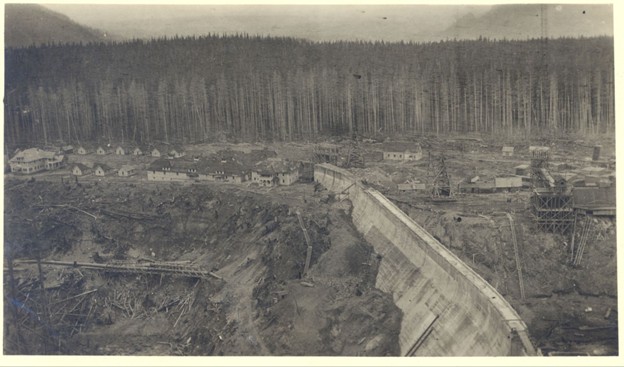
Back in Seattle, City Light received a telephone call just before noon from the power plant in Cedar Falls, warning of the encroaching flames. Seattle’s water supply appeared safe for the moment, but if the power plant burned, the city would lose a significant portion of its electricity. City Light immediately dispatched four firefighters from Hose Company 34 to Cedar Falls to protect the community and the power plant. Meanwhile, the Milwaukee Railroad Company received reports that its Cedar Falls camp was already ablaze, with multiple homes and buildings in flames. By noon, the railroad had lost all communication with Cedar Falls. Phone lines from the power plant and the camps went down at 12:30 p.m. The last message reported that women and children of Camp 2 were seeking refuge in the back side of the masonry dam. Those in Seattle could only send help and wait.


While waiting for assistance from Seattle, at least twenty City Light employees in Camp 2 got to work fighting the rapidly advancing flames. Two massive 7-foot diameter pipelines, also called penstocks, took water from the dam near Camp 2 to the power plant down river in Cedar Falls. Employee Robert Wood was sent to drill holes in the pipes at regular intervals to release water onto the pipes and the structures below. When Wood was about a half mile from Camp 2 on a high bridge over a ravine, his drill bit broke. Below him, flames were already licking at the bridge supports. He had no choice but to turn back through the smoke and heat uphill to Camp 2 for a replacement. With a new bit in hand, Wood fought his way back through the fire, suffering burns to his face and hands. Still, he pressed on, boring hole after hole, releasing jets of water that soaked the vulnerable structures and the pipeline itself.
It was over these gushing pipes that Randall Rydeen and his classmates made their way back to their homes in Camp 2 to help the adults already fighting the fire. As he remembered later, “We went into Rattlesnake Lake on the way up and wet gunnysacks and put over our heads, and Emmett drove on up to the power house in Cedar Falls and we got out and we walked over the pipeline all the way to Camp 2. That’s the only way we could get up there. They had drilled holes in the pipeline walls, they went over wooden trestles and everything, and they would have burned, too. That is what saved them.”


When they reached Camp 2, he recalled that they had nothing but buckets to fight the fire. Otto Mueller, a resident of Camp 2 and City Light employee, was temporarily blinded by the smoke and fire, and many others suffered burns and smoke inhalation injuries. But by working through the night, they saved nearly all the buildings of Camp 2.
The ferocious fire continued to press west, and many buildings in the heart of Cedar Falls were on fire. Hose Company 34, the firefighting crew sent from City Light, made it to Cedar Falls and the Power Plant within two hours and began directing the dozens of men and teenagers who were already fighting the fire. They sprayed the roofs with water and chemicals to prevent the power plant and surrounding community from burning. That evening, a reinforcement force of fifty-four men arrived from Seattle. The weather continued to work against them, but by 3 a.m. on June 1st, they were able to declare the power plant saved.

At the same time, employee homes at the Milwaukee Railroad Camp were engulfed in flames. Many residents took shelter inside the concrete Milwaukee substation as their homes and belongings were incinerated in a matter of minutes. H. M. Clark had to carry his elderly in-laws from his burning house while his wife desperately sprayed water on the roof with a garden hose. Ultimately, they abandoned their efforts and drove to the substation with their two children and Mrs. Clark’s parents, both in their 80s. Their house, and over two dozen others, were destroyed. In the Milwaukee railroad yard, lumber, railroad ties, and railroad cars caught fire. When a tank containing 24 carloads of fuel oil ignited, the burning oil created an inferno with flames shooting hundreds of feet into the air, dark billowing clouds of smoke filling the valley.

Farther south, employees at Kent Lumber Company Camp No. 5 fought the fire until the property was declared lost. They had to flee to the Cedar River to escape the flames, occasionally dunking themselves underwater when the heat became unbearable. Pacific States Lumber Company lost three logging camps, miles of railroad, numerous pieces of equipment, train cars, and significant amounts of lumber. Many bunkhouses and homes were destroyed. One employee, an unnamed Japanese immigrant, lost $8000 in liberty bonds (the equivalent of about $150,000 today); they later found burned remnants of the certificates. This must have been a heartbreaking loss for a man who likely purchased those bonds during WWI as an investment and a way to support his adopted country.

As the fire spread from Cedar Falls, it moved southwest along the Cedar River watershed and west over Rattlesnake Ridge. In the early morning hours of June 1st, the small logging community of Kerriston lay directly in its path. Women and children fled on makeshift rafts onto the large millpond and waited through the night, expecting their homes to burn. Luck was on their side, however, as the fire shifted course just before reaching the community.


By the morning of June 2nd, the weather had cooled, the wind died down, and dew covered the fire-scarred landscape. Remarkably, despite all the destruction and the fire’s rapid advance, no one lost their lives in the Cedar Falls fire.[1] Several men were reported missing but were later found safe. The schoolhouse in Cedar Falls, initially reported destroyed, actually survived intact. A bee farm directly in the fire’s path survived with all colonies unharmed, and the power plant supervisor’s black cat, which ran into the burning forest during the fire, found its way back home the next day.
The Seattle Times estimated that monetary losses from the fire had reached approximately $600,000. The fire started on Mount Washington from sparks emitted by a Pacific States Logging Company donkey engine, a portable steam-powered winch used for moving logs out of the forest. H. M. Clark, the man who had saved his family from the fire at the railroad camp, purchased the claims of 32 other Cedar Falls residents who lost their homes. He then sued Pacific States Logging Company for negligence. The suit was settled out of court for $30,000 in August 1923.

The Cedar Falls fire was not an isolated incident. That same day, fires erupted across the Pacific Northwest, from British Columbia to Oregon, driven by heat, low humidity, and strong winds. Logging communities throughout the Cascades faced similar threats as perfect fire conditions met dry, flammable forests and felled lumber. Indeed, every fire season brought the threat of catastrophic disaster in communities where escape routes were limited and firefighting resources scarce.
References:
“Camps are Hard Hit.” Seattle Daily Times, June 1, 1922. Page 5.
“Cedar Falls Surrounded by Flames, Heavy Loss.” Seattle Daily Times, June 1, 1922. Page 1, 4.
“Cherry Valley Fire Hit by Tree Fatality 1922.” Wildland Fire Lessons Learned Center. Accessed January 3, 2025. https://lessons.wildfire.gov/incident/cherry-valley-fire-hit-by-tree-fatality-1922.
“Flames Surround Town! Cedar River Women Children Flee” and “Seattle Light Plant System is Threatened” and “One Man Killed Fighting Flames.” Seattle Daily Times, May 31, 1922. Page 1.
“Firemen Save Big Power Plant: Heroic Deeds Are Performed.” Seattle Daily Times, June 1, 1922. Page 1, 5.
Gilder Lehrman Institute of American History. “Appealing to Immigrants.” 2019. https://wwichangedus.org/wp-content/uploads/2020/04/06-Source-Spotlight-Appealing_to_Immigrants.pdf.
“Great Destruction to Property Caused By Fire Demon That Attacked Little Town of Cedar Falls.” Seattle Daily Times, June 1, 1922. Page 29.

“Logging Company Pays $30,000 Fire Damage.” Seattle Daily Times, August 11, 1923. Page 2.
“Must Seattle’s Bathing Beaches Remain Closed” and “More Record Breaking Hot Days” and “The Weather.” Seattle Daily Times, May 30, 1922. Page 1.
Rydeen, Randall E. “Working and Living at the Cedar River Watershed, 1916-1929.” HistoryLink. Essay 2453. Accessed October 16, 2025. https://www.historylink.org/File/2453.
“Save Their Lives by Taking to Water, Not Daring to Quite Water.” Seattle Daily Times, June 1, 1922. Page 5.
Stein, Alan J. “Cedar Falls — Thumbnail History.” HistoryLink. Essay 2537. Accessed October 3, 2025. https://www.historylink.org/File/2537.
“Vast Damage Caused by Forest Fires.” Seattle Daily Times, June 1, 1922. Page 1.
“Weather is Big Help in Fight Made on Flames.” Seattle Daily Times, June 2, 1922. Page 1, 4.
Wilma, David. “Forest Fires Sweep Eastern King County on May 31, 1922.” HistoryLink. Accessed October 3, 2025. https://www.historylink.org/File/2915.
“Women and Children on Rafts While Blaze Rages.” Seattle Daily Times, June 1, 1922. Page 1, 5.
[1] *A separate fire on May 31st consumed a Cherry Valley Lumber Company camp in Stillwater, farther north in the Snoqualmie Valley. A 19-year-old firefighter named Leo McDonald was killed by a falling tree.
[Featured image: Photograph of Camp 2 and the Masonry Dam at Cedar Falls housed at the Snoqualmie Valley Museum. PO.284.0070]