-Guest post by Deborah J. Isley, volunteer Snoqualmie Valley Museum
Sometimes a historian finds a source so rich in detail and variety that it can become a fixation, the kind of source that could spawn a dozen articles and lead a researcher down a hundred rabbit holes.

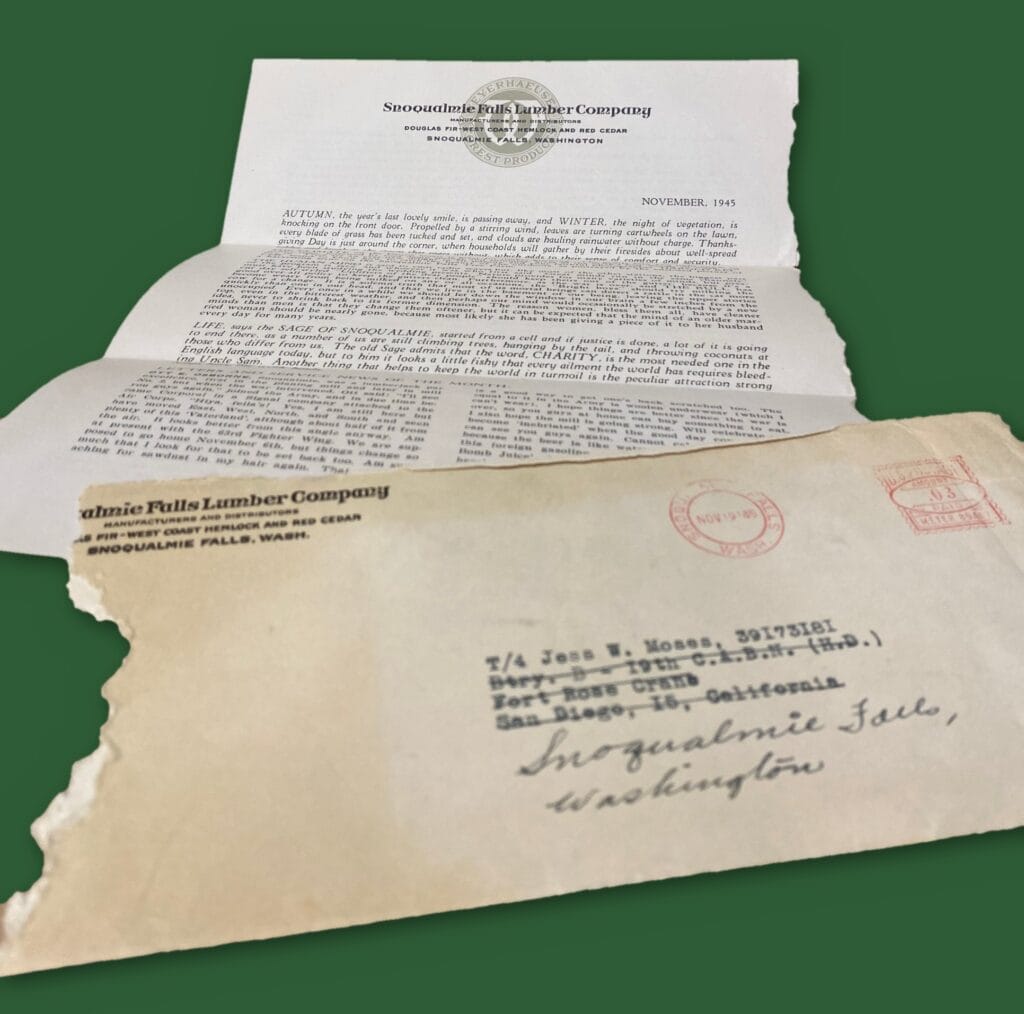
This year, in the Snoqualmie Valley Museum archives, I spent time with just such a collection. The Snoqualmie Falls Lumber Company Newsletter to the Troops was a monthly letter published from 1942–1945. During World War II, industrial newsletters like this were published by companies throughout the country and served multiple purposes.
First, they were sent to hometown troops serving across the country and overseas to keep them connected to what was happening on the home front. Second, they included news of the war and of local soldiers serving in the armed forces for employees and families still in the local community. Finally, they were meant to keep up morale, encourage participation in the war effort, and instill a sense of purpose for the communities at home and the soldiers serving around the world.
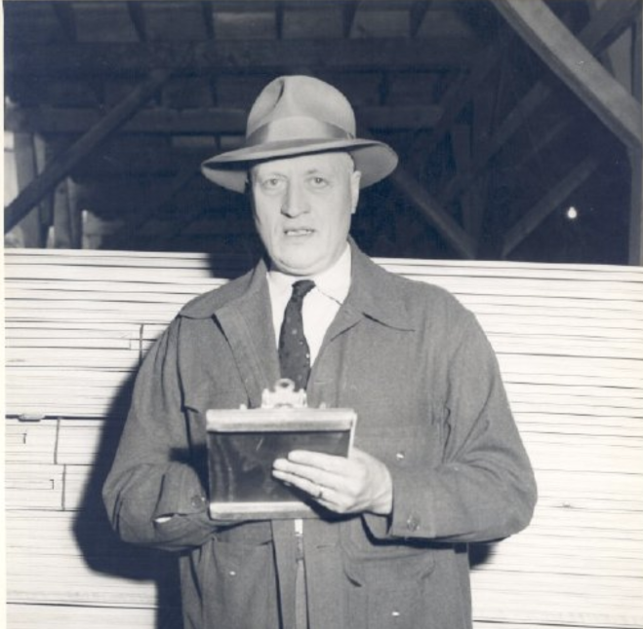
The Snoqualmie Falls Lumber Company Newsletter was edited by Art Benson, a company manager who called himself a “Scribe” and the “Sage of Snoqualmie.” Two to four pages long, each newsletter also included a photograph taken by Harold Keller, a well-known and prolific Snoqualmie Valley photographer. From June 1942 to November 1945, Benson’s newsletter shed light on how this community experienced World War II. In an early newsletter in August 1942, Benson wrote:
“We are not making any sensational headlines at home, just plugging along, keeping the wheels of industry going and the home fires burning. When the boys join the armed forces, the girls put on a pair of overalls and go to work; in fact, women in industry are so common now that the men workers have lost their awe for them (August 1942).”
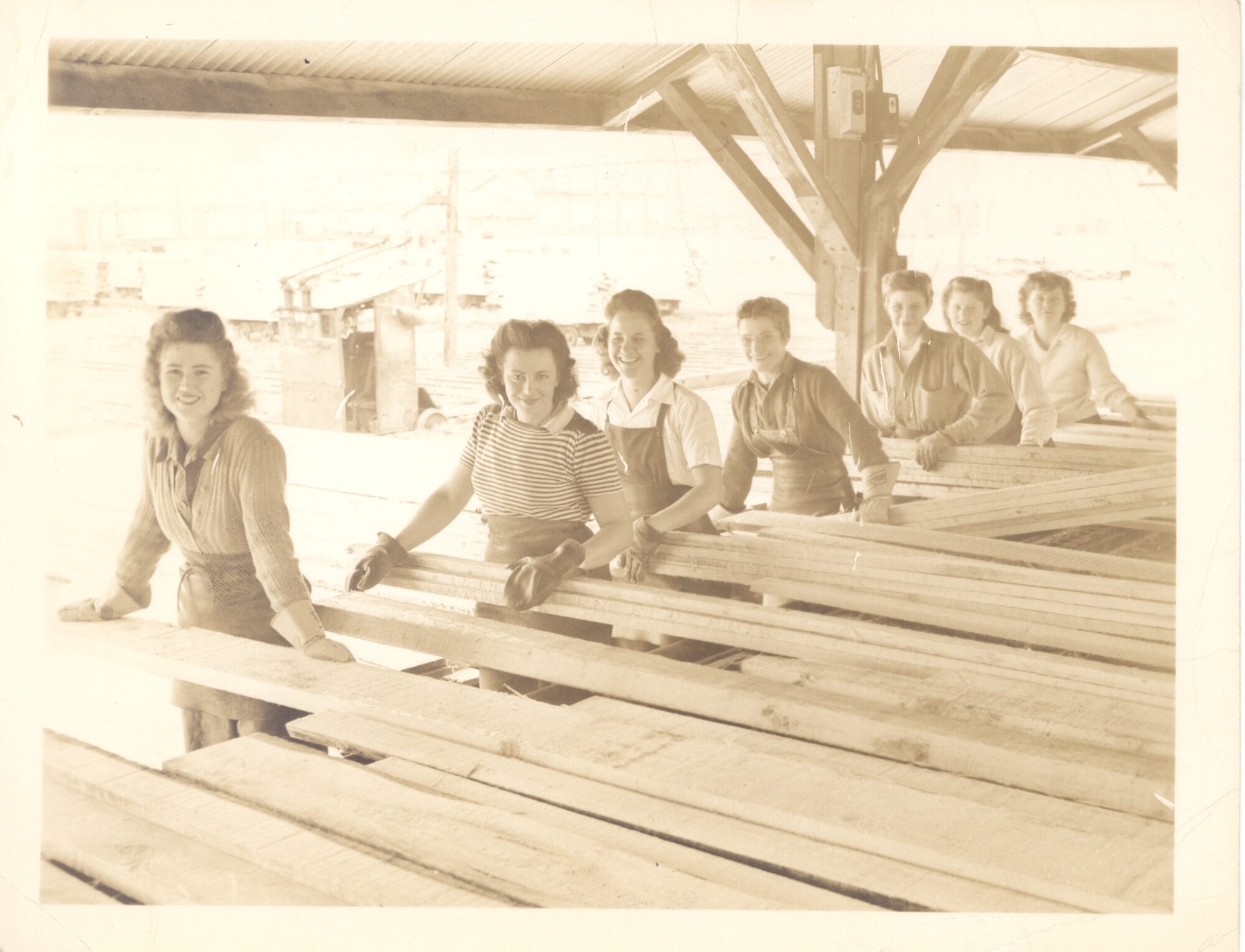
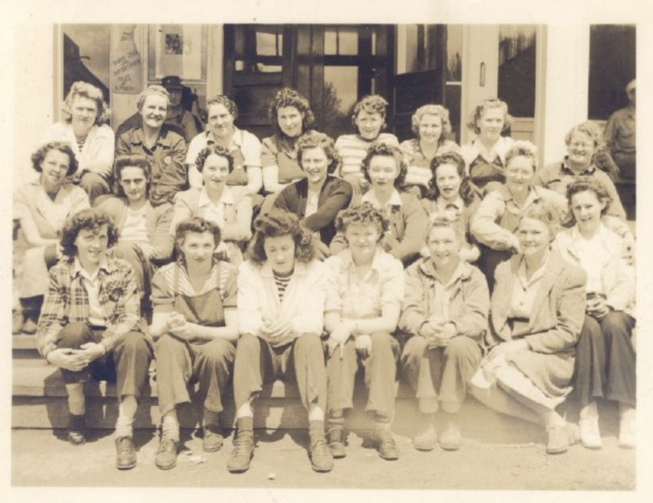
Indeed, many of Keller’s photographs highlighted the timber industry’s new female workforce. Local women, often just out of high school, worked at the lumber mill to replace the young men fighting in the war. Benson noted that “the women are showing us how to win the war” (July 1943). The lumber industry was vital to the war effort, Benson asserted, so these women were essential to an Allied victory.

The newsletter included lighthearted and charming portraits of life in the valley. In August 1942, Benson told the story of a false air raid alarm that woke Snoqualmie residents. Air raid marshals and ordinary citizens jumped out of their beds but soon discovered that instead of approaching enemy aircraft, an apricot truck had caught fire on Main Street and spilled fruit all over the road. Apparently, someone meant to blow a fire alarm but accidentally alerted the town to an approaching air attack. Once the residents were assured they were safe, they “supplied themselves with their winter supplies of apricots, some of which were nicely roasted and ready for canning” (August 1942).
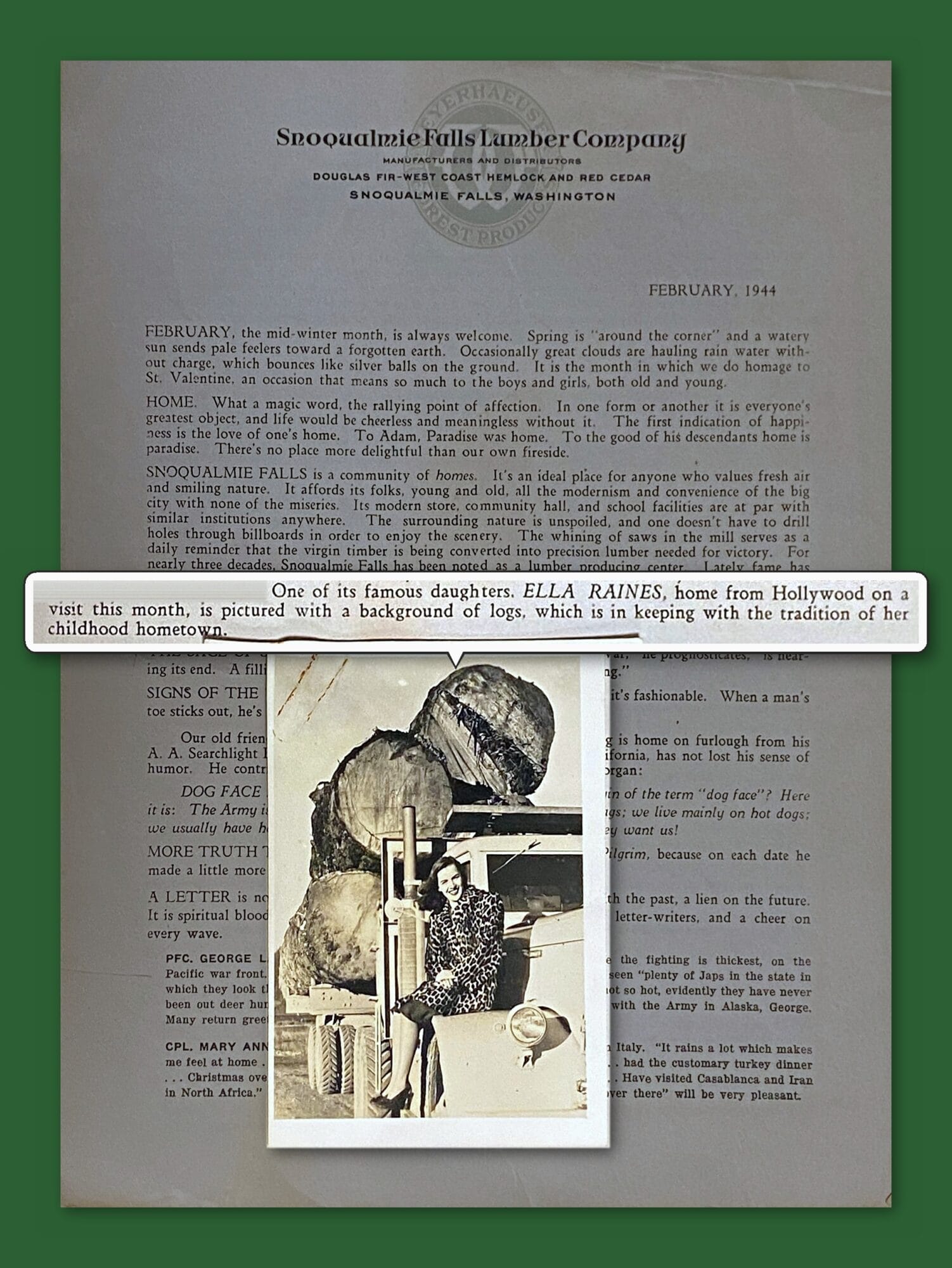
Benson often opened these letters with a description of the valley at that moment: “Every field is in bloom, the woods are in full leaf, and the year in its highest beauty” (July 1943); “Spring is ‘around the corner’ and a watery sun sends pale feelers toward a forgotten earth” (February 1944); and “Surrounded by Green-Clad foothills of the Cascades and looking down at the floor of the lush-green valley below, life is still pleasant at Snoqualmie Falls” (September 1945). Service members loved hearing about the weather and seasons in the valley. The beauty of home was often discussed in the excerpts of soldiers’ letters included each month.
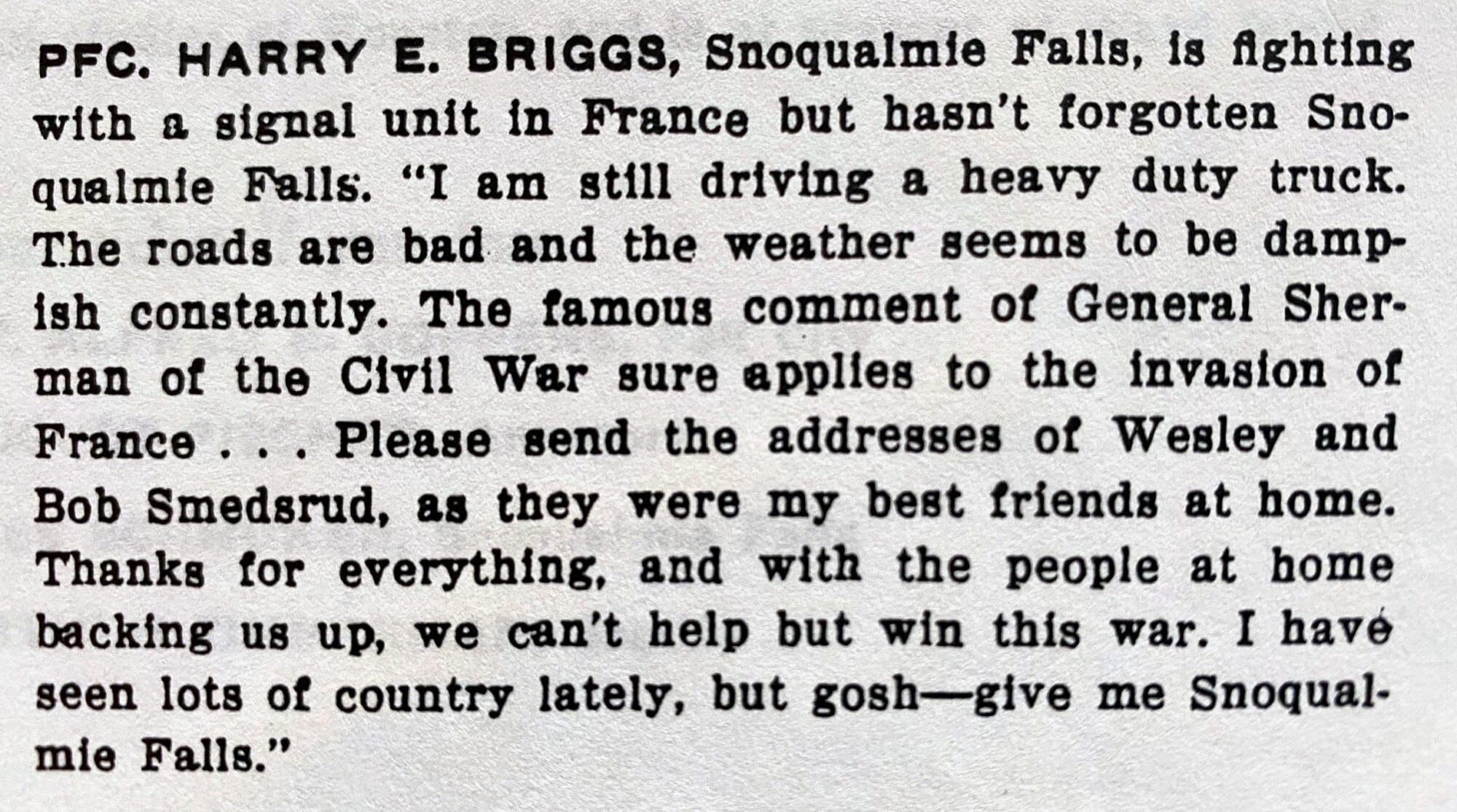
PFC Robert Johanson, who was stationed in England, wrote, “This place is not so bad, but I miss the tall timber. I hope to be back someday to the best country in the world, the Pacific Northwest” (March 1944). While stationed in France, PFC Harry E. Briggs noted that he had “seen lots of country lately, but gosh—give me Snoqualmie Falls” (October 1944). Soldiers were homesick for the land, but also the people and the work. Many expressed a yearning to be working in the lumber lines again.
Occasionally, the letters would discuss the skills learned at the lumber company and how they contributed to their abilities in the armed services. When Pvt. Iven Riggle was training at Camp Pendleton in California, he wrote that driving the jitney, a small motorized carrier used to haul lumber around the mill, gave him the experience needed to drive a tank. “Like a jitney,” he wrote, “These tanks can tip over. Leave it to me to find out. I rolled one down the side of one of these mountains the other day” (July 1944). PFC Henry Zurflueh mentioned that while stationed in France, one of the movies played for the soldiers was called “Lumbering in the Pacific Northwest.” Zurflueh felt proud that the movie highlighted the importance of lumber to the war effort.
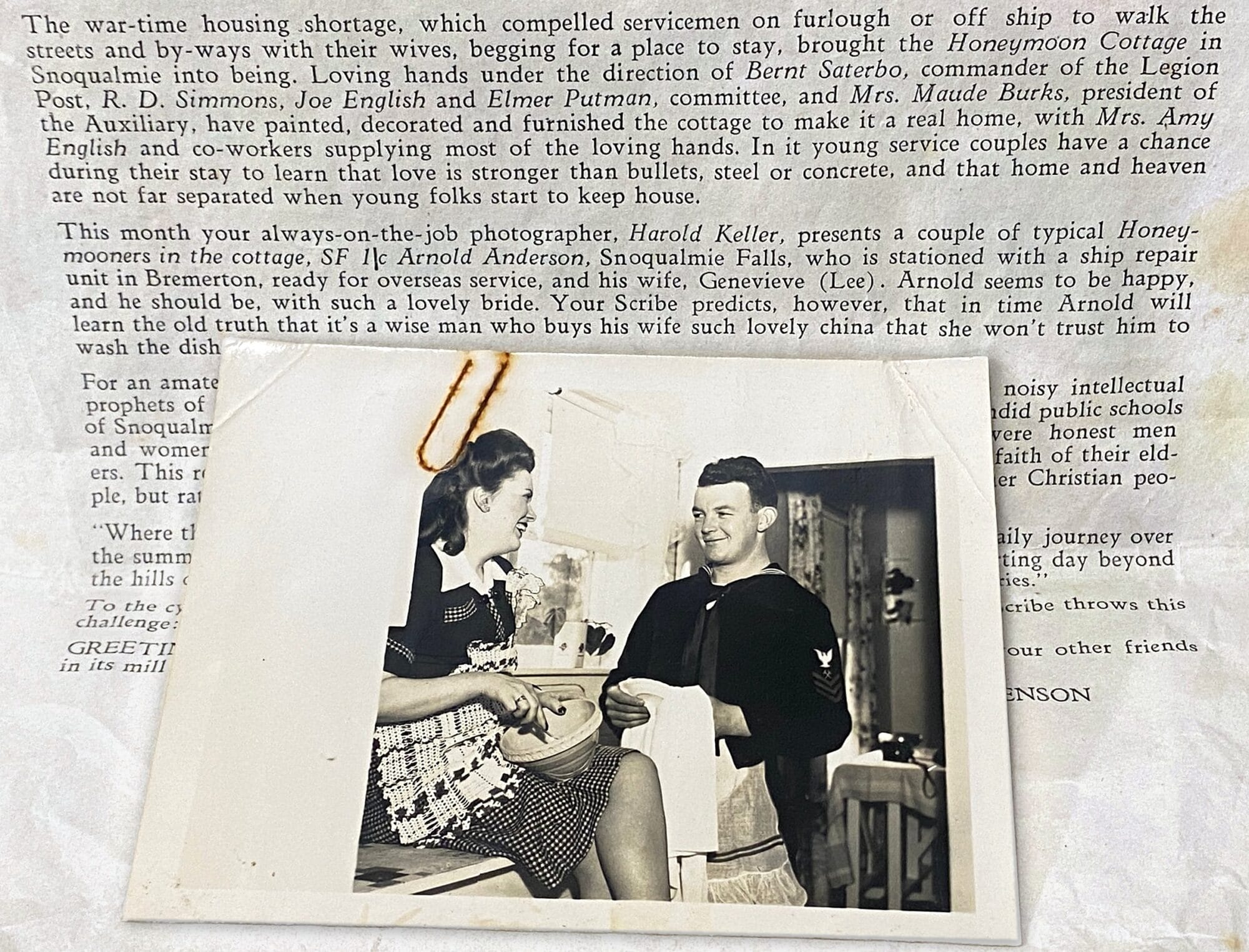
The soldiers appreciated being able to hear about what was happening at home, but also what was happening with their friends, coworkers, and classmates stationed all around the world. Sometimes soldiers wrote that they ran into someone they knew from home or that it was comforting to know that former classmates and coworkers were relatively nearby on the front lines. The letters were censored, and soldiers could not describe their location or activities in any real detail.
Fireman First Class (F1c) Primo Filippi, serving in the South Pacific, wrote, “There isn’t much I can tell because it would be cut out” (July 1944). Still, soldiers found other ways to convey their experiences and their interactions with local populations. S/Sgt. Joseph Proctor, serving in Sardinia, wrote that the local population seemed at ease with a slow pace. “They have the slowest oxen and the most beautiful churches in the world” (March 1944). S/Sgt. Gust Soderstrom, likely stationed in the South Pacific, wrote of the heat, mud, and abundance of coconuts and sugar cane.
The weather and the food were common preoccupations in the letters to home, likely because so much else was censored. Occasionally, a soldier could write about witnessing a historic event unrelated to the war. Cpl. Charles “Bud” Judd wrote in March, 1944 that he “had the opportunity to witness the eruption of Mt. Vesuvius. It was quite a sight at night to see the lava belch forth and roll down the sides” (June 1944).
There were hints at the misery of war: the hunger, housing crises, destruction, and death. PFC/Cpl. Harry Briggs was in France after the invasion. “The famous comment of General Sherman of the Civil War sure applies to the invasion of France” (October 1944). Briggs was likely referring to Sherman’s famous quote, “war is hell.”

Snoqualmie Valley women serving in the Army, Navy, Marines, and Army Air Forces were included as well. Some women joined the WACs (Women’s Army Corps). PFC/Cpl. Roberta Leake, a former Snoqualmie Valley school teacher, served in Italy and was awarded the Bronze Star for meritorious service in connection with military operations. PFC Evelyn Offield served in New York City, and Sgt. Mary Ann McBane’s service took her to Italy, Casablanca, and Iran. At first, Art Benson noted that many women from the valley were hesitant to join the armed forces because jobs in King County’s aviation, shipbuilding, and lumber industries were so plentiful.
Still, in 1943, Carol Hoyem, who worked in the front office at the lumber mill, resigned her position and joined the Marine Corps Women’s Reserve, a group known as the “Leathernecks” (October 1943). Of course, war was dangerous for all servicemembers. Elizabeth Erikson of Preston was serving in Texas with the Women Airforce Service Pilots (WASP) when she was killed during a training flight, just a week shy of her twenty-third birthday.
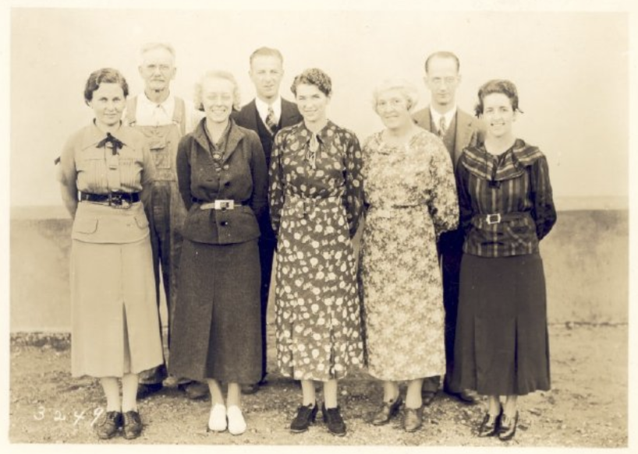
Most letters included an “In Memoriam” section for the service members who died. Some died on American bases, like Elizabeth Erikson and Lt. Bernard Briggs. Others died in battle in the South Pacific, Africa, and Europe. James Allan Machan was serving with the Army Rangers when he was killed on Omaha Beach on D-Day, June 6, 1944. In the South Pacific, Marine Pvt. Lloyd P. Scheel of Snoqualmie was killed during the Tarawa campaign on November 27, 1943 (February 1944).
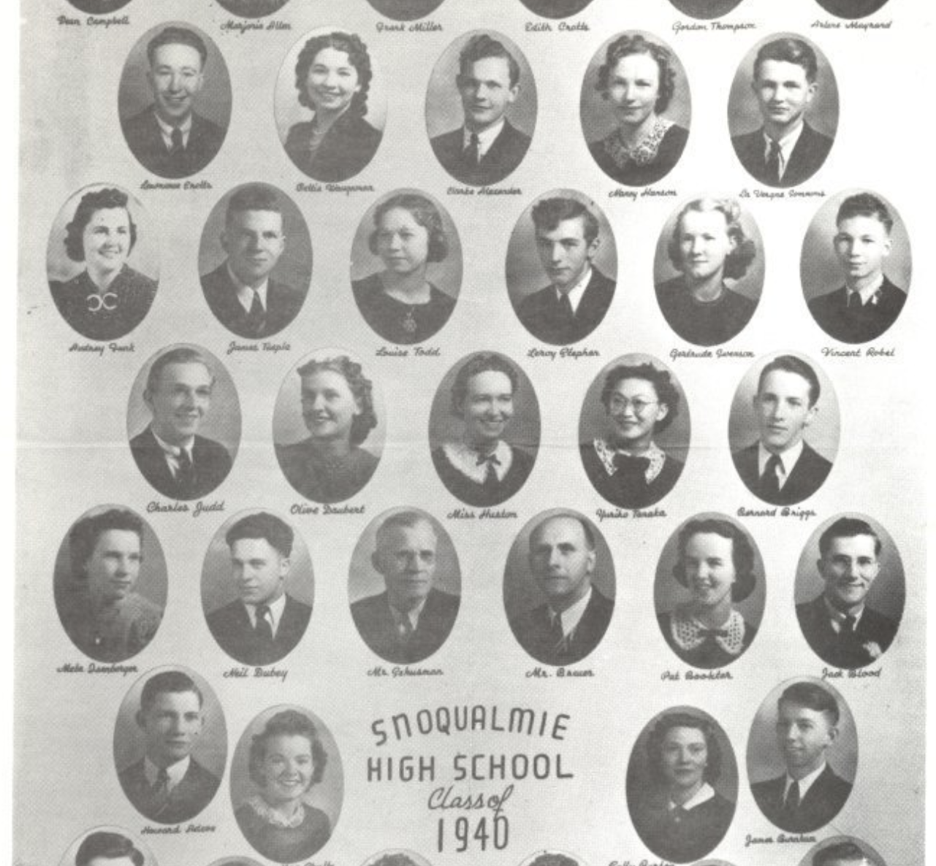
The memorial section included biographical information, which often highlighted how young these men and women were. T/5 Lawrence “Bud” Crotts died on May 31, 1944, in Italy, likely in the Allies’ advance on Rome. The newsletter mentions that before joining the Army, Bud was a “four year letterman in football at Snoqualmie High School” (July 1944).
There are so many service members from the Valley included in these newsletters. They are a rich source for research and for gaining an understanding of what this community was like during the Second World War. Most of us do not remember what it was like when the entire nation mobilized for war. These newsletters remind us of the sacrifices communities across America made, sacrifices carried most heavily by young men and women.
References
- Benson, Art. “Snoqualmie Falls Lumber Company: Newsletter to the Troops.” June 1942–November 1945. Photocopies of originals. Snoqualmie Valley Museum, North Bend, WA. Object no. 473.561.
- HonorStates.org. “Lawrence L Crotts: Technician Fifth Grade from Washington, World War II Casualty.” Accessed November 12, 2026. https://www.honorstates.org/profiles/438935/.
- HonorStates.org. “James Allan Machan: Technician Fifth Class from Washington, World War II Casualty.” Accessed November 12, 2026. https://www.honorstates.org/profiles/121566/.
- HonorStates.org. “Lloyd Paul Scheel: Private from Washington, World War II Casualty.” Accessed November 12, 2026. https://www.honorstates.org/profiles/622458/.
- “Working in Wartime.” Homefront: Connecticut Businesses in World War II. University of Connecticut Library, Archives & Special Collections. Accessed November 13, 2026. https://library.uconn.edu/location/asc/about/homefront-connecticut-businesses-in-world-war-ii/working-in-wartime/.
[Featured image: 721.104a-e. Original letter and envelope sent to Technician Fourth Grade Jess W. Moses in November 1945.]