~Guest Post by Noah Heutchy, BS in Social History, Snoqualmie Valley Historical Museum Volunteer
We are all probably familiar with American tall tales, Paul Bunyan and Johnny Appleseed being amongst the most famous. These tall tales are based on truth; however, the facts and events are exaggerated. While “Cougar” Pete Peterson is not a tall tale on the scale of Bunyan and Appleseed, like them the facts surrounding his life have been embellished over the course of time into a new tale of his life. This story was then passed down to the point that it is believed to be factual.

The summary of Peterson’s life is often conveyed as he was a great hunter of predators, especially cougars, and that is why he was called “Cougar Pete.” He was an outdoorsman who hunted and killed a huge grizzly bear and its pelt is now part of the Smithsonian Institution. Peterson was appointed by President Franklin Roosevelt as the first Forest Ranger of what is now the Snoqualmie National Forest. He met Roosevelt at the Cascadia or Olympic Hotel in Seattle and the two of them had a long conversation.
What parts of this tale are based in fact, and which have been exaggerated? And how can one tell the difference?
If you look through the various records in the Snoqualmie Valley Historical Museum archives, you will find pictures, articles, writing, and artifacts pertaining to Peterson. Most of the writings about him are secondary sources. A secondary source is one that is created later by someone who did not have first-hand experience, for example, newspaper articles or statements from his descendants. When it comes to research, historical or not, the most reliable information comes from primary sources. These are immediate first-hand accounts. The issue that often arises is that secondary sources are more plentiful than primary, but they can carry mistruths that are then perpetuated. The challenge with primary sources is that they tend to be less available. It is through analyzing and comparing these various sources that historians can make the best assessment of what likely happened.

From various primary sources, it is possible to piece together some basic facts about Peterson that are not disputed. His full name is Peter Christian Peterson, though he sometimes went by Peter Charles Peterson. He was born on March 3,1880 in Denmark and immigrated to the United States in 1904, arriving by ship in Boston. When he was 44 years old, he married Selma Thompson and they had one child, a daughter, also named Selma. Throughout the years, the United States Federal Census records his occupation as a hunter and guide and then in his later years as a laborer at a water main construction company. He lived in Snoqualmie in 1920 and in Renton by 1930.
It is very hard to ascertain events of Peterson’s life from these primary sources. They give facts, but not stories. Secondary sources give a fuller picture of Peterson. While these sources can be less reliable, newspaper articles written close to the time the events occurred are more likely to be accurate than articles written years later.

The stories of Peterson’s life usually refer to him as Cougar Pete because he was a bounty hunter of cougars. There are several photographs in the Snoqualmie Valley Historical Museum archives showing Peterson’s cougar kills as well as several articles in various newspapers. However, it is an article published in 1939 in the Seattle Star that specifically states that he known as “’Cougar Pete’ because of the 150 mountain lions he has slain since 1907.” There is overwhelming evidence that Peterson killed many cougars, and with deduction and reasoning and no alternate explanation, the claim of Peterson’s nickname is substantive.
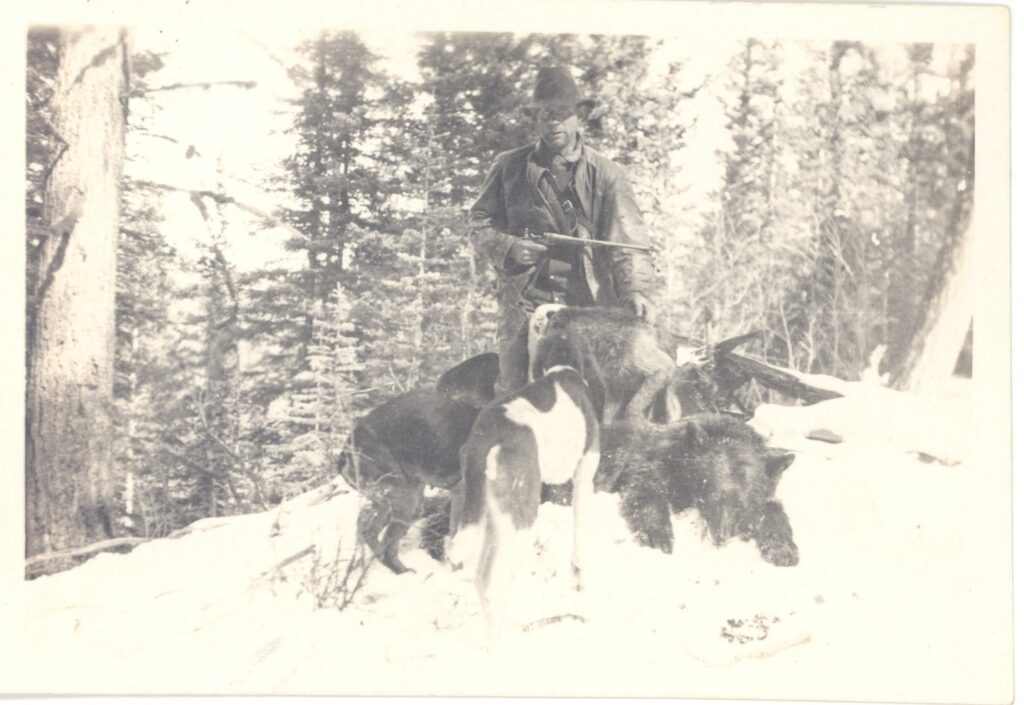
The claim that Peterson killed a large grizzly that was later stuffed and added to the Smithsonian Institute’s collection makes sense considering he was a government hunter. Peterson himself wrote a booklet about hunting this grizzly in which he tells the tale of the hunt and gives the date of the kill as August 26, 1923. His booklet says nothing about the Smithsonian. A Seattle Daily Times article published shortly after the hunt states that Peterson killed a grizzly bear that was estimated to weigh 1000 pounds. The bear had killed 35 cattle and 150 sheep before being caught. The article states that “the trophy will be sent to Washington to be mounted for display in the Smithsonian Institute which has no grizzly bear from this state.” Peterson’s own tale along with this article confirms that he killed a large grizzly. However, while the paper confirms the plan to donate the pelt and preserved skull, I have been unable to verify if the bear was ever received by the Smithsonian. This leaves some uncertainty around the claim.

Several secondary sources, including Peterson’s own obituary, mention that he was the first United States Forest Ranger of the Snoqualmie National Forest and was appointed to that position by President Theodore Roosevelt. Like most things, these assertions are based on truths in Peterson’s life, but a review of available information reveals some fiction mixed in with those truths.
The original forest rangers were political appointments made by the state or federal GLO or a U.S. Senator. With the establishment of the United States Forest Service in 1905, a mere year after Peterson came to the United States, forest rangers ceased being political appointees. A hiring process began that required both written and field examinations. The President of the United States never appointed forest rangers, therefore the claim that Peterson was appointed a forest ranger directly by President Theodore Roosevelt is false.

While he was not directly appointed by President Roosevelt, the question remains, was Peterson a forest ranger and if so, was he the first ranger of the Snoqualmie National Forest? The Snoqualmie National Forest was established in June 1908 through a presidential executive order. A Seattle Daily Times article announcing this states that “Snoqualmie is the appropriate name which has been given to the southwest portion of what was formerly known as the Washington (West) with an area of approximately 1,004,166 acres.” Peterson is not mentioned in this article. However, he is mentioned as a Forest Ranger in conjunction with participating in a manhunt in an April 1908 article in The Seattle Daily Times. If this is the correct title for Peterson, it predates the existence of the Snoqualmie National Forest.
It is possible that Peterson was a Forest Ranger for the Washington East division of the national forest prior to the 1908 realignment. A Seattle Daily Times article dated September 14, 1907, announced “P.C. Peterson has been appointed guard of the Washington (Yakima division) national forest.” It is important to note that this is different than the west national forest that later became the Snoqualmie National Forest. Further examination of news articles from the time shows that it is also possible that guard of the national forest meant government hunter. He is mentioned as working as a hunter in connection with the forestry department in the Leavenworth Echo as early as October 1908. An article published in 1909 in the Seattle Daily Times clarifies this role, stating that he was appointed the government hunter for the state of Washington in 1907, and further explains:
Peterson was appointed government hunter when the forestry service created like positions in several other states at the suggestion of ex-President Theodore Roosevelt. He was recommended for the position by the mountain farmers who had already become aware of his prowess in killing the animals that devoured his livestock.
A state hunter’s job was to protect wildlife and farm animals by hunting down and killing dangerous predators. Therefore, guarding the animals of the forest areas. A government hunter earned $95 per month, plus the bounty awarded to each eligible kill, which was enough at the time to live on. The fact that Roosevelt suggested the position of government hunter in various states is most likely where the idea that Peterson was appointed directly by Theodore Roosevelt came from.


In the 1920 United States Federal Census, a primary source, Peterson states that his occupation is hunter, which indicates he considered it his primary job. In the 1930 census, he stated his occupation as hunter and guide. While various newspaper articles in the early 1900s sometimes refer to Peterson as a forest ranger, it is always in the context of his hunts. Therefore, it seems most likely that his position of government hunter was often confused with that of a ranger. Because of this uncertainty, one cannot completely rule out whether he worked as a forest ranger. However, it is fact that Cougar Pete was appointed the first government hunter for the state of Washington.
The final part of the story claims that Peterson met President Theodore Roosevelt at either the Olympic or the Cascadia Hotel in Seattle. Peterson’s own granddaughter relayed this tale to Snoqualmie Valley History Museum Staff in 2002. This was recorded in the Summer 2002 museum newsletter in which it was written:
An episode that stands out in family lore is of Pete’s meeting with President Theodore Roosevelt, when the president was in Seattle. He had heard of Cougar Pete and wanted to meet him, so Pete was invited to the Olympic Hotel where TR was staying. It is said the two men had a long visit, swapping tales.
It is likely true that Theodore Roosevelt knew about Peterson and wanted to meet him. A 1929 Seattle Daily Times article states, “when Mr. Roosevelt was visiting the Pacific Northwest, he sought to arrange to have Peterson guide him on a cougar hunt back in the Cascades.” The article goes on to explain that Peterson was in a remote area of the state hunting, and they could not meet within the time frame Mr. Roosevelt was available.
It is well documented that President Theodore Roosevelt visited Seattle in 1903. However, Cougar Pete did not immigrate to the United States until 1904. Roosevelt again visited in 1911, two years after he left the presidency. He arrived by ship and then was driven up to the University of Washington where he visited the residence of President Kane and later gave a speech in an open-air theatre on campus. Afterwards, Roosevelt dined with three hundred and fifty prominent citizens at the Hotel Washington and gave a speech before heading to the Press Club. After a ride to King Street Station, he boarded his private rail car where he spent the night. The next morning the train headed for Spokane. The most likely time for Cougar Pete to have met Theodore Roosevelt would have been if he was one of those 350 guests at the Hotel Washington. However, no record of that meeting has been found. While the story of meeting Roosevelt might be true, it is impossible to determine.
Over time, it is easy for history to become distorted with retelling. One job of historians is to examine the available evidence to determine what was most likely accurate. Cougar Pete Peterson was a highly regarded man who was well-known as a hunter and guide. There are records of him killing numerous predatory animals, helping rescue lost hikers, and even helping track down a murderer. Exaggerations of his life are not needed to show what an impact he had on the Snoqualmie Valley and the state of Washington.
[Featured image PO.274.0016 – Peterson on horseback, surrounded by his hunting dogs with the bear he killed]
Sources:
- 1920 United States Census, Snoqualmie Township, King County, Washington; sheet 3A, dwelling 53, line 7; January 16, 1920; National Archives Microfilm T625, Roll 1925.
- 1930 United States Census, Elliott Precinct, King County, Washington; sheet 1A; dwelling 6, line 9; April 2, 1930; National Archives Microfilm T626, Roll 2490.
- “Colonel Teddy Seattle’s Guest, Has Busy Day.” The Seattle Daily Times, April 7, 1911, 1, 14.
- “Cougars Come Close to City Boundaries.” The Seattle Daily Times, January 25, 1910, 9.
- “’Cougar Pete’ Petersen dies at 95.” The Seattle Daily Times, June 4, 1975, H7.
- “Cougar Pete Swaps Tales with President Theodore Roosevelt.” Snoqualmie Valley Historical Museum Newsletter (North Bend, WA), Summer 2002, 4.
- “Forest History Society – by Understanding Our Past, We Shape Our Future.,” Forest History Society, May 7, 2024, https://foresthistory.org/.
- Lindeman, Charles B. “Face to Face with Killers of the Wild.” The Seattle Daily Times, January 6, 1929, 5.
- “Miller Died at Hands of Mike Petrige.” The Seattle Daily Times, April 15, 1908, 5.
- “National Forests Redistricted.” The Seattle Daily Times, July 14, 1908, 8.
- “New Appointments Made.” The Seattle Daily Times, September 14, 1907, 3.
- “Nimrod Tells of Adventure in Woods.” The Seattle Daily Times, March 3, 1909, 1,4.
- Peter Christian Peterson petition for naturalization. National Archives and Records Administration at Seattle, record group 21, vol. 146, 1944.
- Peterson, Charles Peter. Taking an Outlaw Grizzly. Denver, CO: Outdoor Life Publishing Co., 1924.
- Smith, Randolph. “Veteran Hunter Joins Party Seeking Boy Lost in Wilds.” The Seattle Star, July 13, 1939, 16.
- “State’s Famed Grizzly Slain Terrorized Okanogan County.” The Seattle Daily Times, August 31, 1923, 17, 19.
- “The Government Hunter.” The Seattle Daily Times, March 15, 1909, 6.
- “Town and Country.” The Leavenworth Echo, October 16, 1908
- William, Gerald W, Ph.D. The USDA Forest Service – The First Century. Washington, D.C.: USDA Forest Service Office of Communication, 2005.