Last week, after several days of steady rain, Jillian Medford was relieved to see the sun return.
Like many beekeepers, she knew her colonies had been unable to forage while the weather kept them confined to their hives. When the skies finally cleared, the change was immediate.
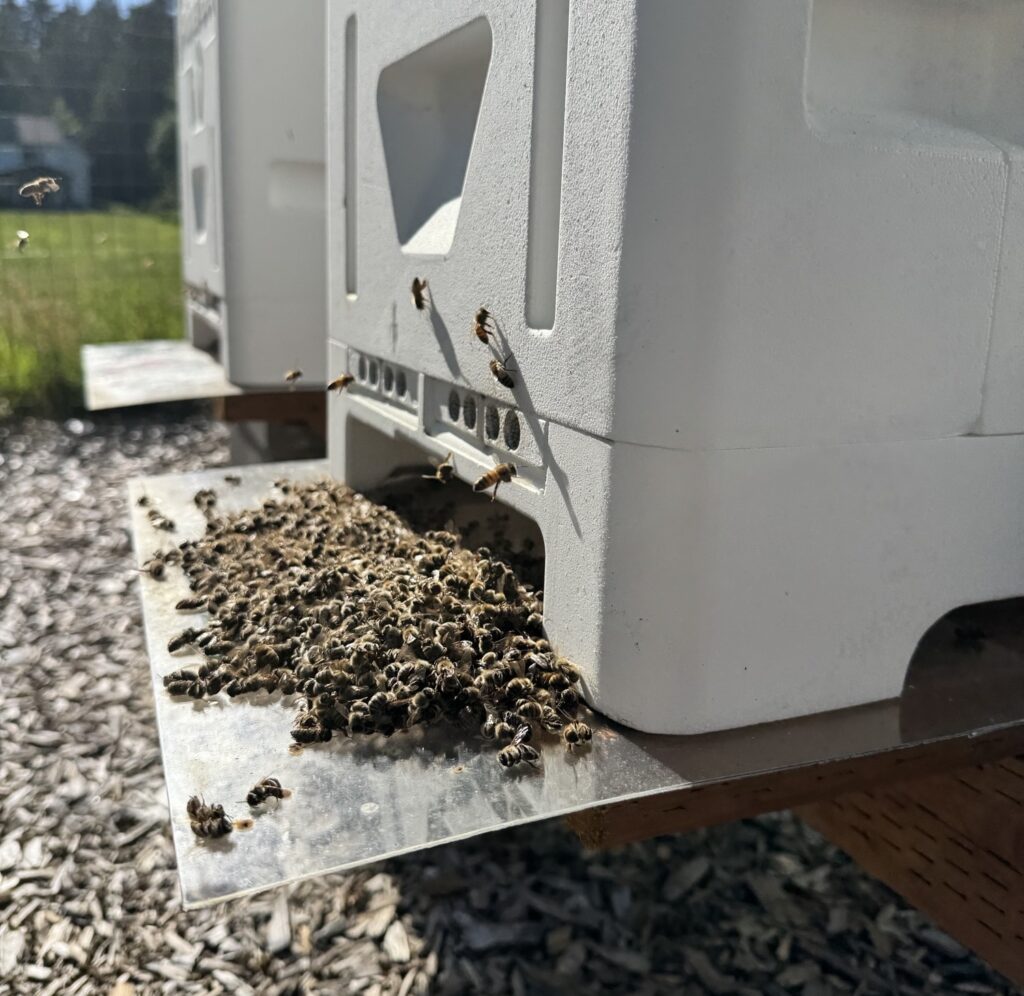
“The moment the sun returned, the foragers were out in full force, to make up for lost time,” said Medford, owner of The Keeper’s Collective. About 24 hours later, she went out to check on her hives and found three colonies had suffered what she described as massive die-offs.
“More than three-quarters of each colony was dead on the entrance boards and scattered across the ground in front of the hives, and the dead bees had their proboscises (their tongues) hanging out,” she said.
Medford keeps 12 hives. Three were decimated. A few bees remain in two of those colonies, and she said she has done everything she can to help them recover. Whether they survive, she said, remains to be seen. The colonies that did survive have been severely weakened.“A sudden loss of multiple hives, paired with those extended tongues, are two very distinct signs of pesticide poisoning,” Medford said.


“Whoever sprayed couldn’t have picked a worse moment,” she said. “Choosing to spray right after a long rain, just as every forager in the area is out working, is about the most lethal timing there is.”
Although Medford suspects a nearby pesticide application was responsible, she said identifying the source is nearly impossible in a rural area surrounded by neighboring properties. “Unless it’s a golf course or a city application, which generally has to be documented, it’s virtually impossible to know who sprayed what,” she said. “That’s what makes this so frustrating.”

Medford said she has spent the past six years raising awareness in her community about the impact of pesticide use, not just on honeybees but on native pollinators as well. “I think it comes down to an ‘out of sight, out of mind’ mentality,” she said. “People like to believe that a small spray here, or a once-a-year treatment, doesn’t matter. It absolutely does.”
She does not believe the spraying was intentional and suspects someone was simply treating a yard without realizing what it would do. For the past three summers, Medford said she has seen other signs that her bees may have been exposed to pesticides, even when there was no large-scale die-off.
“At least once or twice each summer, I’ve gone out to check on my bees only to find them confused, walking around on the ground, disoriented, and unable to find their way back into the hive,” she said. “It’s heartbreaking to watch.”
Medford said those incidents highlight a lesser-known aspect of pesticide exposure. A colony does not have to experience a sudden die-off to be affected. She said exposure can interfere with a bee’s ability to navigate, preventing foragers from returning home, weaken immune systems, increase vulnerability to varroa mites and the viruses they carry, cause brood loss, or affect a queen’s ability to lay eggs.
She also said that contaminated pollen and nectar brought back to the hive can continue to affect a colony long after spraying has occurred. “So even when I don’t find piles of dead bees, I’m often seeing the ripple effects of something in the environment,” she said.
The financial impact of losing three colonies extends well beyond the bees themselves. Medford said a new nucleus hive, or starter colony, costs between $300 and $500, while the thermodynamic hive bodies she uses to help colonies withstand environmental stressors cost $850 each. With three hives sitting empty or occupied by weakened colonies, she said she has effectively lost a third of her annual honey harvest.
Those expenses are only part of the equation. Medford said beekeeping requires ongoing investments in natural mite treatments, habitat improvements and feeding bees their own honey rather than sugar water to help keep them healthy. Rebuilding colonies also requires a significant amount of time and labor. “Beekeepers are up against so much: pesticides, yes, but also climate change, varroa mites, and the viruses that take hold once colonies are weakened by all of the above,” she said.

While honeybees are the most visible victims of pesticide exposure, Medford said they are far from the only pollinators affected. Native bees, bumblebees and other wild pollinators face many of the same pressures, including climate change, habitat loss, monoculture farming and disease. She noted that roughly one in three bites of food people eat depends on pollinators, making their health important well beyond the beekeeping community.
“The hard part is how invisible it feels,” Medford said. “A homeowner spraying for weeds, a business treating its landscaping, a property manager keeping the grounds tidy: none of them intend to hurt anything, and none of them ever see the damage. But that one spray didn’t just kill three of my honeybee colonies. There’s no telling how many wild pollinators went with them, and those don’t have a beekeeper to notice they’re gone.”
“Here is the part most people don’t realize,” Medford said. “A single bee will travel two to three miles from her hive to find flowers, so one resident spraying on one afternoon can reach bees from several different hives at the same time. That means a single yard can wipe out multiple honeybee colonies at once. And that is only what we can count. The native bees and bumblebees visiting those same blooms have no hive and no keeper, so when they’re gone, no one even notices. The ripple from one yard travels much farther than you’d think.” Sprayed leaves and blooms can also remain toxic to bees for hours or even days after an application, she said.
She said homeowners and businesses do not have to stop caring for their landscapes, but small changes can make a significant difference. Among the steps she recommends are avoiding spraying plants that are in bloom, applying products in the evening when bees are no longer foraging, mowing the lawn beforehand to remove any flower heads, reading labels carefully and choosing the least harmful option available. She also pointed to alternatives such as hand-pulling weeds, mulching, boiling water, flame weeders and corn gluten meal. Even products marketed as natural, she said, can harm bees if applied directly to them. “Whatever you choose, the rule is the same,” she said. “Keep it off the blooms, and use it when the bees aren’t flying.”
“If you know there are hives nearby, a quick heads-up to the beekeeper lets them protect their bees while you work,” she said. “If you’re not sure, ask. I would so much rather a neighbor call me with a question than have me find another pile of bees on the ground.”
Through The Keeper’s Collective, Medford has spent years creating pollinator habitat and educating others about the challenges bees face. She said much of the solution comes down to awareness and understanding how individual decisions can affect pollinators far beyond a single yard.
“We share this valley with these creatures, and small, thoughtful choices are genuinely what keeps them here,” she said. “The bees can’t choose where they fly. They depend on all of us to keep this valley safe for them, and in return they keep it blooming and fed.”