[By SVSD Parents for HiCap. Views expressed are those of the author, not the Living Snoqualmie website. You may submit letters to [email protected].]
For ten years, the Snoqualmie Valley School District has offered a full-time classroom for its most academically advanced elementary students. This year, the children who earned their place may not get one.
Seven 1st graders in the Snoqualmie Valley School District have been identified as needing accelerated instruction in both math and reading. Under state law, that level of need is part of their basic education. For a decade, the district’s answer for these students has been STREAM, a full-time, full-year classroom built specifically for them.

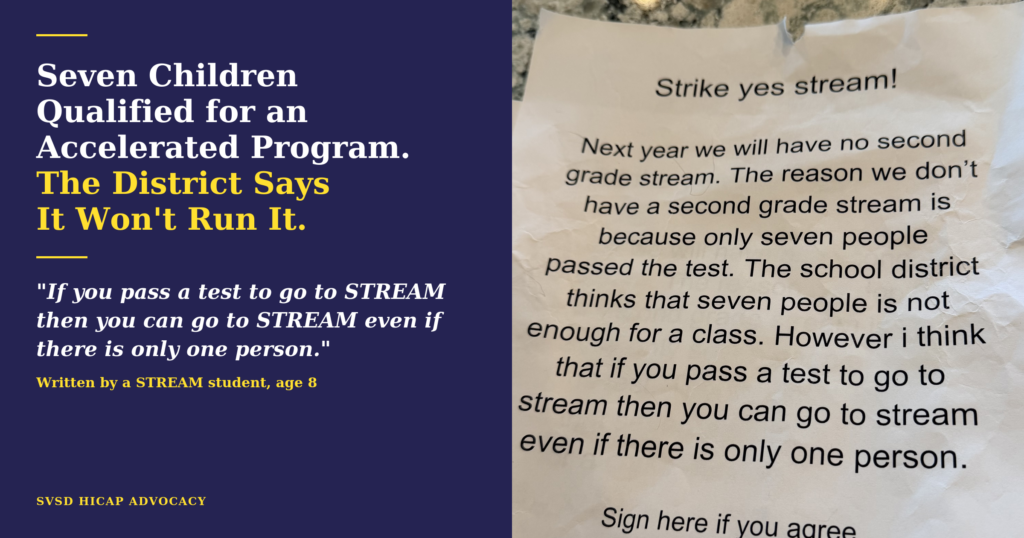
This year, the district has told families it will not run the 2nd-grade class next year. The district says seven children are not enough.
It is the first time in STREAM’s ten-year history that a 2nd grade class will not run. The children who qualified are being offered an alternative that the district has historically reserved for students who do not qualify for STREAM: a “cluster” classroom with potential pull-out or push-in services. The details are vague, and parents with students in current clusters say they feel no difference in their children’s education.
This is not about whether the district is doing a good job with most students. It is doing an excellent job. SVSD won the State Superintendent’s Award for Educational Excellence in March 2026 and is among the top-ranked districts in Washington. The question is narrower and more specific: when seven students meet the criteria for a program the district itself built and the law treats as part of their basic education, what justifies taking it away?
STREAM is not the cluster program
STREAM was created by the district in 2016 to serve students who are working well above grade level in both math and reading. Students are identified through a multi-year body of evidence, including cognitive testing and academic performance. Those who qualify learn in a dedicated classroom alongside peers at the same level, with curriculum paced to match their actual readiness.
The results have been remarkable. In fall 2025, 52 Washington students scored in the national top 10 percent of the Noetic Math Contest, which more than 35,000 students enter. Nine of those came from STREAM classes at Snoqualmie Elementary, the most from any single public elementary school in Washington state.
The district’s alternative for the seven students is a cluster classroom, possibly supplemented by pull-out or push-in services from a highly capable specialist. As of this writing, no specific hours of specialist time have been committed. The details remain undefined. Parents whose children are already in cluster groupings say the experience is largely indistinguishable from a general-education classroom. Cluster is a grouping inside a regular classroom. STREAM is the classroom. A ten-year program with measurable results is being replaced, for these seven children, by an offering that does not yet have a schedule.

Washington state law is specific on this point. RCW 28A.185.020, codified in 2011, defines access to accelerated learning and enhanced instruction as access to a basic education for highly capable students. New WAC rules taking effect in June reinforce that districts must provide services matched to each student’s identified needs. An undefined alternative is not equivalent to a full-time classroom when the identified need is full-time accelerated learning and enhanced instruction.
Why so few were identified
If seven students seems low, it should. A group of SVSD parents formed an advocacy organization, SVSD Parents for HiCap, to understand why. They conducted an anonymous survey and 61 families across 9 schools responded. The findings point not to a small population of qualifying students, but to an identification process that families and even teachers do not understand.
- 92 percent of surveyed families did not know that Acadience Reading scores are used in highly capable identification. None of the 28 kindergarten and first grade families surveyed knew.
- 77 percent said their child’s teacher could not explain how the identification process works.
- 60 percent said the district never communicated with them about the process before their child was evaluated.
- Families rated the district’s communication about highly capable programs at 4.7 out of 10, compared to 7.9 for general school updates.
WAC 392-170-042 requires districts to notify families about the highly capable program in multiple ways, with circulation adequate to reach all families. Ninety percent of survey respondents said they want to learn more about highly capable programs. Zero said no.
The process itself is difficult to pin down. Parents found four different descriptions of the same identification process published by the district, none of which match. One page still publishes a scoring threshold the superintendent says is no longer used. At a recent board meeting, a board member acknowledged on the record: “I can’t speak to exactly how it goes in the room. I’m not in that room.” Families and board members alike are on the outside of a decision that shapes children’s educational paths.
The inconsistencies extend to direct communication. The district website describes the qualifying threshold as mid- to upper-90th percentiles in general, with no distinction between subject areas. But in a recent email to a family, the HiCap program coordinator described a stricter standard:
“For qualification in mathematics, the committee looks for consistent, sustained performance in the upper 90th percentiles, specifically in the 98th and 99th percentiles, across mathematics achievement and cognitive data over multiple years.”
Not a single family surveyed, including current STREAM parents and parents whose children were considered, was aware that a higher threshold applied to math. When the criteria depend on which document a family reads or which staff member they email, the result is not a process. It is a moving target. Children who would qualify under one description may not under another.
The students spoke first
When word reached current STREAM students that the incoming 2nd grade class might not run, 70 of them organized a paper petition at school on their own, collecting signatures during recess and after-school programs. They did not wait for adults to lead. They were speaking up for the seven children coming in behind them. Children they have never met, but whose education they recognized as their own.
The Change.org petition that followed exists because the students made clear what they wanted their district to do.

What parents are asking
SVSD Parents for HiCap sent Superintendent Schlotfeldt and all board members a presentation after the May 7 school board meeting, covering the survey findings, research on gifted education outcomes, the new state regulations, and the contradictions in the published identification process.
The group is not asking the district to lower standards. They are asking the district to honor the standards it already has, and the law it is already bound by. Their five asks:
- Run the 2nd grade STREAM class for the students who earned their place
- Fix the identification process so it reaches every family, as state regulations require
- Make the appeal process fair and transparent
- Strengthen the cluster program so it delivers real accelerated learning rather than enrichment on a Chromebook
- Build a K-12 pathway so highly capable services do not disappear after elementary school
The full presentation and the details behind each ask are available at https://svsdhicapadvocacy.org/the-ask.
What is at stake
Seven children have done what was asked of them. They sat for the assessments, met the criteria, and were identified as needing the program the district built for exactly this purpose. The district has the resources, the teachers, the funding, including levy dollars that specifically name STREAM, and a decade of evidence that the program works.
This is about whether the district gives these students what they actually need, which is what both the spirit and the letter of the law require. There is still time. The school year is not over, and the district’s decision is not yet final.
How to help
- Sign the petition: change.org/p/don-t-cancel-2nd-grade-stream
- Learn what assessments feed into highly capable identification at your child’s grade level: svsdhicapadvocacy.org/important-dates
- Read about families’ rights under the new state regulations: http://svsdhicapadvocacy.org/know-your-rights Join SVSD Parents for HiCap for updates: svsdhicapadvocacy.org/join
- The next SVSD school board meeting is May 21. Public comment is open to anyone who wishes to attend.
SVSD Parents for HiCap is a group of Snoqualmie Valley families working to improve how the district identifies and supports highly capable students. The group is not affiliated with SVSD or any PTSA.
Website: svsdhicapadvocacy.org